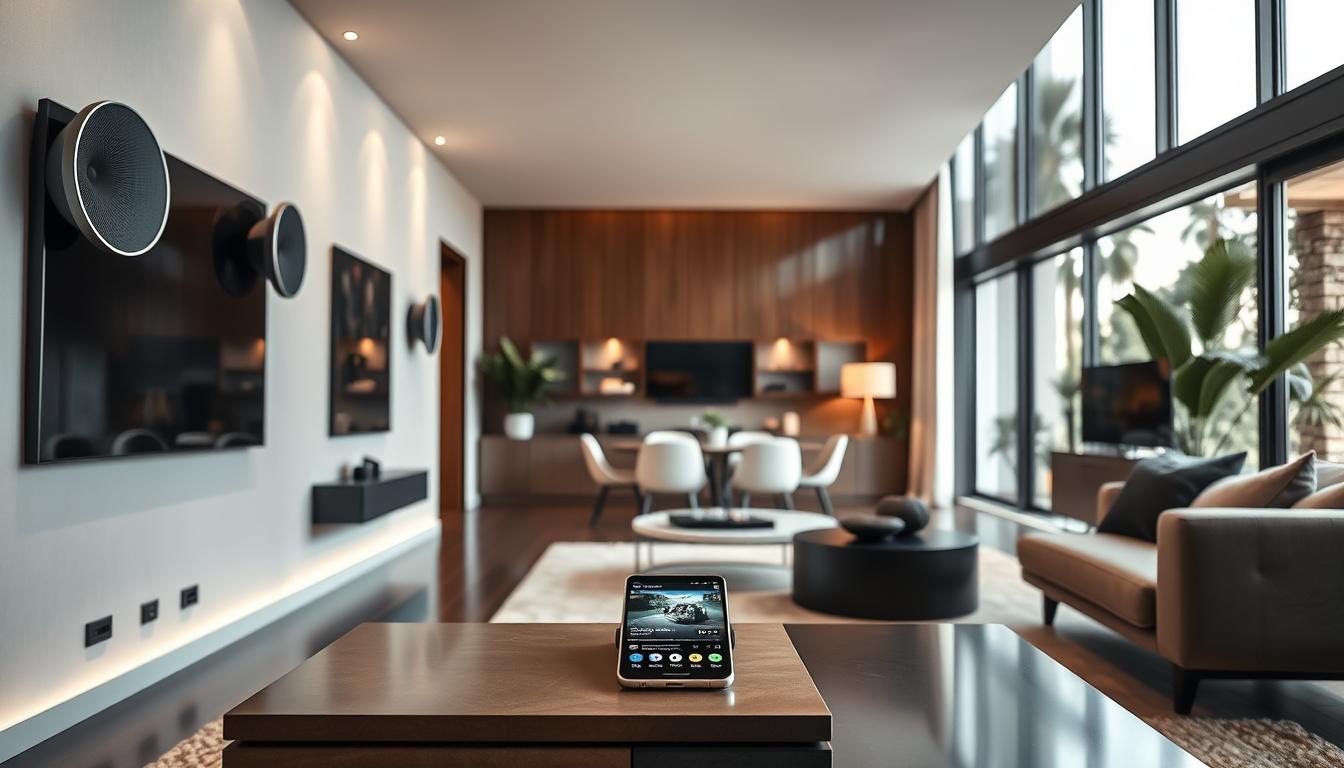
Do you remember carrying your boombox everywhere? Those days are over. Today, whole-home audio systems are way smarter.
Now, sound follows you like a perfect butler. It knows when you want NPR in the kitchen and hip-hop in the gym. It’s not just background noise; it’s a story told through speakers.
Modern multiroom setups make your home sound better. They know your daily routines better than your body clock. From morning news to evening tunes, everything works smoothly.
Imagine an orchestra where every room plays its part. Yet, they all work together in perfect harmony. Welcome to the new era of home sound.
Wired vs wireless vs hybrid approaches
Choosing audio infrastructure is like deciding between a constitutional amendment and a Twitter poll. Wired systems are like the Supreme Court of audio—stable, reliable, and lasting for generations.
They offer flawless synchronization and zero latency. Your architectural speakers become a permanent part of your home’s design. No interruptions during Beethoven’s crescendos or Kendrick’s verses.
Wireless systems are like the House of Representatives. They’re flexible and adaptable but can be gridlocked by connectivity issues. Ideal for spontaneous patio parties or kitchen dance-offs. But, your Wi-Fi might protest.
Hybrid approaches are the legislative compromise that works. They mix wired reliability with wireless flexibility. Use wired for main areas and wireless for seasonal spaces.
This blend lets streaming platforms shine while keeping audio quality high. Your architectural speakers handle key areas. Wireless satellites cover extra spaces. It’s audio federalism at its best.
Consider these factors when choosing your approach:
- Wired: Maximum reliability, perfect synchronization, requires planning
- Wireless: Instant flexibility, simpler installation, possible interference
- Hybrid: Strategic balance, future-proofing, needs professional design
The best systems use streaming platforms as content sources with a wired backbone. It’s like having a digital library with physical masterpiece paintings. The content flows freely, the foundation remains solid.
Your choice depends on whether you prefer audio perfection or adaptive convenience. Or if you’re wise enough to want both.
Zone planning: public vs private spaces and patios
Think of your home as an acoustic democracy. Different spaces need different sound rules. Zone planning helps sort out the sound.
Public areas like kitchens and living rooms need clear sound. You should be able to hear recipes and feel movie scores. It’s all about balance.
Private areas like bedrooms and studies need softer sounds. They’re places for sleep and focus. Here, sound should be gentle.
The patio is a different story. Weather and wildlife can mess with sound. Directional speakers help keep sound in check.
DSP (Digital Signal Processing) is like an audio peacekeeper. It adjusts sound based on what you’re doing. Smart systems use DSP to get it right.
| Space Type | Audio Priority | DSP Setting | Speaker Placement |
|---|---|---|---|
| Public (Kitchen/Living) | Clarity & Coverage | Voice Enhancement | Ceiling/Corners |
| Private (Bedroom/Study) | Precision & Privacy | Near-field Optimization | Wall/Bookshelf |
| Outdoor (Patio/Deck) | Durability & Direction | Weather Compensation | Overhead/Directional |
When your system gets spatial politics, magic happens. It knows dinner needs different sound than jazz. That’s smart zone control.
Modern DSP does more than adjust volume. It considers content, noise, and time. Morning news gets treated differently than evening shows. That’s smart audio.
The best systems adapt to life’s changes. Kids grow, parties happen, and work-from-home becomes common. Your audio should change with your life.
Speaker choices: in‑ceiling, in‑wall, invisible, landscape
Choosing speakers for your home audio system is like putting together a team. Each type has its own strengths. They all come together to create a great sound.
In-ceiling speakers are like the background actors. They blend in and provide a consistent sound. They’re great for adding atmosphere without being too loud.
In-wall speakers are the stars of your audio system. They project sound well and are perfect for main areas. Think of them as the main actors in your living room.
Invisible speakers are like the silent heroes. They hide in walls or ceilings, leaving only sound. They’re perfect for those who love a clean look.
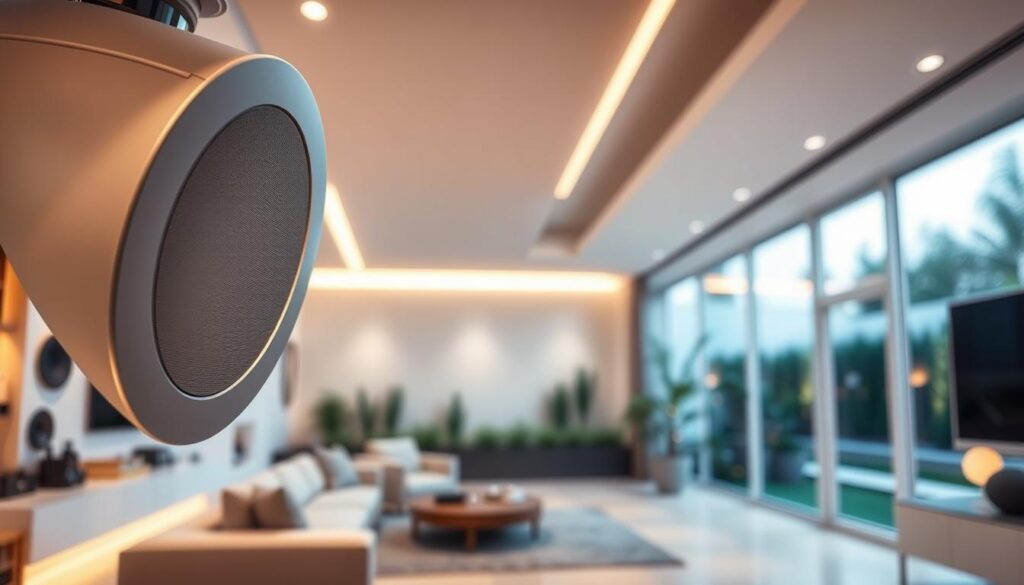
Landscape speakers are built for the outdoors. They handle weather and deliver great sound. They’re like the stunt doubles of the audio world.
The magic of multiroom audio systems is how different speakers work together. Your streaming platforms help them all play their part. It’s about finding harmony, not competition.
Every room in your home needs its own audio character. The kitchen might need in-ceiling speakers for background sound. The home theater needs in-wall speakers for a big sound. Outdoor spaces need landscape speakers to handle the weather.
The real magic is when all these speakers work together. Your streaming platforms help them switch smoothly from room to room. It’s like having a team that performs just when and where you want.
Choosing speakers isn’t about finding the “best” one for everything. It’s about finding the right one for each role in your home. This way, every speaker adds to the overall sound without taking over.
Amplification, DSP, and room correction
Think of your audio system as a rock band. The speakers are the lead singer, but without proper amplification, they’re just whispering poetry in a hurricane. Amplification isn’t about raw power—it’s about precision delivery, like a sommelier pairing the perfect wine with each course.
Enter DSP—the digital signal processor that’s basically your audio’s personal therapist and stylist combined. This clever tech applies acoustic filters that make your music sound better than reality itself. It’s the difference between watching a raw documentary and seeing the IMAX director’s cut.
Room correction might be the most overlooked superstar in audio. Your room has acoustic baggage—weird dimensions, reflective surfaces, that awkward nook where sound goes to die. Room correction listens to these problems and says “I got this,” applying corrections that would make a Feng Shui master proud.
Together, these three elements transform ordinary architectural speakers into intelligent instruments that understand their environment. They create an experience where music doesn’t just play—it lives and breathes in your space.
Consider these essential components:
- Amplification: Clean power delivery that makes your speakers sing without strain
- DSP processing: Real-time audio optimization that’s smarter than your smartest friend
- Room correction: Acoustic therapy that fixes your space’s bad habits
The magic happens when all three work together. Your system becomes more than hardware—it becomes an audio instrument that knows your space better than you know your favorite playlist. It’s the difference between hearing music and feeling it in your bones.
Streaming ecosystems and hi‑res considerations
Streaming services have grown from simple music providers to complex audio systems. They know your listening habits better than your therapist. These platforms manage your whole home audio experiences, changing from morning motivation to evening relaxation.
The streaming world is like a high-tech race. Each service claims to have the best algorithms, exclusive content, and sound quality. Spotify, Apple Music, Tidal, and Amazon Music lead the way, each adding something special to your multiroom audio.
The hi-res audio debate is like asking if the emperor has clothes. The technical specs are impressive, with 24-bit/192kHz files holding more musical data than standard streaming. But can you really hear the difference? Sometimes yes, sometimes it’s like buying organic carrots for no reason.
The truth about hi-res audio in whole home audio systems is complex. It’s not just about the format. Your fancy FLAC files won’t sound better without good speakers or a well-treated room.
Here’s what really matters in multiroom audio setups:
- Source quality: Higher bitrates provide more musical information
- System capability: Your equipment must actually reproduce those details
- Listening environment: Acoustics matter more than file format
- Practical considerations: Bandwidth and storage requirements
The smart way to use hi-res in whole home audio is strategic. Use higher resolutions in key listening areas like the home theater or music room. Standard quality is fine in the kitchen or bathroom.
Modern multiroom audio systems handle this smartly. They stream different qualities to different zones based on your network and speaker capabilities. It’s like having the right music for the right room at the right time.
Streaming platforms are like digital music librarians, but with better recommendations and no judgment. The magic happens when these services work well with your whole home audio system. They create a musical experience that fits your life, not the other way around.
Source sharing, lip‑sync, and TV audio handoff
Ever seen a debate where the audio doesn’t match the speaker’s mouth? That’s what bad lip-sync feels like in your home theater. You paid good money for this disappointment. Modern streaming platforms have made our living rooms like multiplex cinemas. But they’ve also introduced a digital coordination problem that’s hard to solve.
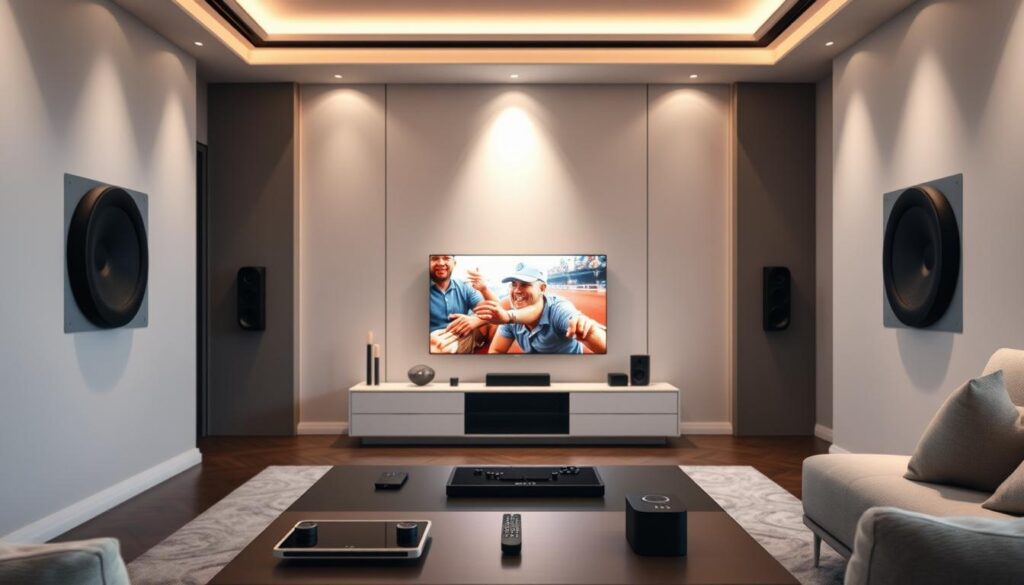
Source sharing isn’t just about playing Taylor Swift in every room. It’s about creating a coherent audio ecosystem. Your podcast shouldn’t stutter when someone flushes the toilet, and your movie dialogue shouldn’t sound like it’s being delivered by a poorly dubbed Godzilla.
The magic happens in milliseconds. Those tiny gaps decide if you get perfectly synchronized audio or if your movie turns into a surrealist comedy. Modern systems use advanced buffering and clock synchronization. It’s like atomic-level timekeeping for your entertainment.
Architectural speakers present their own unique challenges. They’re embedded in your walls and ceilings, so calibration is mandatory. Proper timing adjustment ensures sound arrives at your ears simultaneously, whether it’s beside you or above you.
TV audio handoff might be the most delicate dance of all. When your soundbar passes the audio baton to your whole-home system, there’s no room for fumbles. The best systems handle this transition so smoothly, you’ll wonder if they studied under Fred Astaire.
Here’s what separates professional-grade systems from amateur hour:
- Automatic latency detection and compensation
- Seamless switching between audio sources
- Room-specific delay calibration
- Network stability monitoring
The result? An audio experience so perfectly synchronized you’ll forget you’re dealing with technology at all. Because nothing should come between you and your entertainment—except technical glitches that turn drama into comedy.
Control UX: keypads, apps, and voice
Your audio control system is like a team managing your music. Each part has its own strengths and challenges. The goal is to work together smoothly, without any music mishaps.
Physical keypads are your go-to team members. They’re easy to use and never need updates. Placed around your home, they let you quickly change music and volume. No need to grab your phone for background tunes.
Mobile apps are your digital helpers. They offer flexibility and ease. You can make playlists and adjust volume from anywhere. The best apps are simple to use and work with many streaming services.
Voice control is like your charming spokesperson. Saying “Alexa, play jazz in the kitchen” can feel magical. But, we’ve all had times when it gets things wrong, like “Chillhop” instead of “children’s pop.”
Today’s whole home audio systems use smart DSP to make everything work together. They learn your likes and understand when you want to relax. Your evening tunes should be easy to find.
The key is to have voice, keypads, and apps work together. Use voice for quick things, keypads for fast changes, and apps for detailed settings. It’s about creating a system that fits your mood and needs.
| Control Method | Best For | Limitations | Ideal Placement |
|---|---|---|---|
| Wall Keypads | Quick access, presets | Fixed location | Room entrances, kitchens |
| Mobile Apps | Full system control | Requires device | Anywhere with phone |
| Voice Control | Hands-free commands | Ambient noise issues | Common areas |
| Touch Panels | Rich interface | Higher cost | Main living areas |
The best control system is one you don’t even notice. It should blend into your life, leaving only the music. That’s the aim of good whole home audio control.
Now, DSP systems can predict what you want. They know your daily routines. Morning news in the kitchen, evening podcasts in the study. It should feel like an extension of you, not a complicated tech.
The ultimate goal is a system you forget you’re using. It should fit seamlessly into your life. No need for manuals. Just enjoy your music without interruption.
Prewire and retrofit strategies
Think of prewire versus retrofit as a battle between Frank Lloyd Wright and MacGyver. Wright designs from scratch. MacGyver makes do with what he has.
Prewire is like getting backstage passes to your home’s skeleton. You hide cables before drywall goes up. This way, you get perfect multiroom audio without seeing wires.
Retrofit strategies need creativity. You work with what’s already there. But, modern tech has changed the game. Wireless streaming platforms offer strong alternatives to wires.
Wired connections are more reliable. Wireless tech has improved, but it can’t beat wires. A well-planned wire always wins over the best wireless signal.
The smart choice is a mix of both. Use wires where you can. Add wireless where needed. This makes your multiroom audio system flexible.
Modern streaming platforms make it easy to mix wired and wireless. Your system can grow with new tech.
Your decision depends on your home and how much you want to change it. Prewire gives you perfection. Retrofit offers a chance to make it work. Both can lead to amazing audio with the right plan.
Demo tracks and tuning checklist
Demo tracks are like your audio system’s final exam. They show what your setup can really do. A good playlist tests everything from bass to vocal clarity.
Start with songs you know well. That Beatles track you’ve heard a thousand times? On a tuned system, you’ll hear McCartney’s bass lines with new depth. Steely Dan’s “Aja” becomes a masterclass in separation.
Your DSP settings can turn good speakers into great ones. Digital signal processing corrects room anomalies that plague even premium installations. It’s like giving your audio system glasses – suddenly everything comes into focus.
Create a tuning checklist with frequency sweeps, pink noise tests, and phase alignment. Trust your ears more than any meter. The goal isn’t perfect measurements but emotional connection.
Great architectural speakers disappear when properly tuned. The music feels present, not reproduced. Your DSP settings should enhance, not interfere. The best systems don’t sound impressive – they sound real.
Final test? Play something that gives you chills. If your eyes close involuntarily, the tuning worked. The technology fades away, leaving only the art.