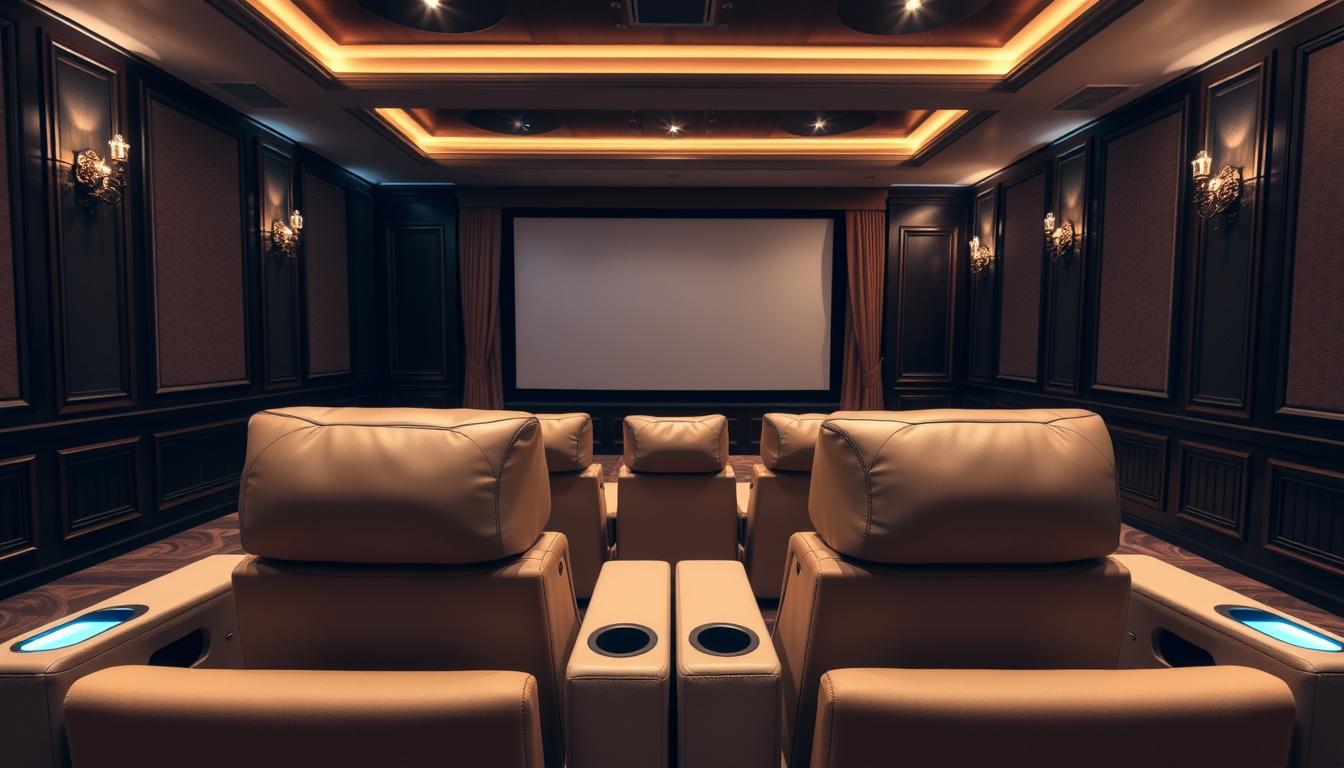
Welcome to your first-world dilemma of epic proportions. Are you building a cinematic sanctuary or creating entertainment’s version of a Swiss Army knife?
I’ve watched clients debate this choice like philosophers at a TED conference. The dedicated space whispers “pure experience” while the multi-purpose approach screams “practical adulting.”
Do you crave that Alamo Drafthouse magic or just better snacks during Netflix binges? The luxury home theater demands commitment – dark walls, fixed seating, and that glorious seating rake ensuring perfect sightlines.
The versatile alternative? That’s having your cake and eating it too. Game nights, sports marathons, and occasional movies. Your decision here dictates everything that follows.
Choose wisely, my media-savvy friend.
Room geometry, sight lines, and seating rake
Remember high school geometry? It’s more than just abstract concepts. Your room’s dimensions shape your movie experience. Get them wrong, and you’ll have a theater that’s more absurd than luxurious.
Rectangular rooms are more than just walls and a ceiling. They’re waiting to be filled with sound. I’ve seen rooms that echo like cathedrals and others with dead spots, like in a Stephen King story.
Sight lines are key, more than your favorite streaming service. Every seat should have a perfect view. No more neck craning or playing musical chairs during the big moment.
The seating rake makes all the difference. A good incline means no more looking at someone’s head during the twist. It’s the difference between watching a movie and being in it.
Think of your seating rake as stadium seating for your home. The slope ensures everyone gets a great view without neck pain. It’s not just about height – it’s about math that would impress Pythagoras.
Your luxury home theater needs better geometry. Bad angles can ruin the magic, making it feel like a middle school auditorium. Get the angles right, and you’re creating an experience, not just a room.
Video choices: projector + ALR screen vs microLED/OLED walls
Welcome to the ultimate display showdown. It’s like choosing between a vintage vinyl collection and Spotify premium. Both deliver music, but the experience is vastly different.
Projectors with ALR screens are the dream of the analog romantic. They need darkness, proper alignment, and the right throw distance. It’s like a fine wine that needs decanting. The payoff is that authentic cinema magic where the image seems to float in mid-air.
MicroLED and OLED walls are the digital perfectionist’s paradise. These sleek panels deliver pixel-perfect clarity, no matter the light. No calibration headaches, no bulb replacements, just instant gratification. It’s like watching a sunset through hand-blown glass versus laboratory-grade optics.
Let’s break down the practical considerations:
- Projector advantages: Massive screen sizes, authentic cinema experience, lower cost per inch
- Projector challenges: Requires controlled lighting, regular maintenance, careful installation
- MicroLED benefits: Brilliant in any light, razor-sharp clarity, virtually maintenance-free
- MicroLED considerations: Higher initial investment, fixed screen size, modern aesthetic
The ambient light rejection screen technology makes projectors more versatile than ever. ALR screens tell stray light to take a hike, preserving contrast even without complete darkness. It’s like noise-canceling headphones for your visual experience.
MicroLED technology has evolved from corporate boardrooms to luxury home theaters. These aren’t your grandma’s plasma TVs. We’re talking about seamless video walls with virtually invisible bezels and stunning brightness levels that make daylight viewing enjoyable.
Your choice reveals your viewing personality. Are you the type who enjoys the ritual of dimming lights and that projector hum? Or do you prefer walking into a brightly lit room and seeing perfect imagery without any setup?
Consider your space, viewing habits, and your tolerance for technical tinkering. The projector route offers classic theater romance but demands more attention. The microLED solution provides modern convenience at a premium price point.
Both approaches can deliver breathtaking results when properly implemented. The real question isn’t which technology is objectively better. It’s which better serves your specific needs and viewing preferences.
Audio: 5.1.4/7.1.4 Dolby Atmos layouts and speaker placement
If traditional surround sound is like watching a movie, Dolby Atmos is like being in the storm. It’s the difference between hearing about a thunderstorm and feeling it hit your coffee table.
Setting up these systems is more than just following rules. It’s about creating the perfect sound space. Ceiling speakers aren’t just for rain sounds; they make you feel like you’re part of the movie, not just watching it.
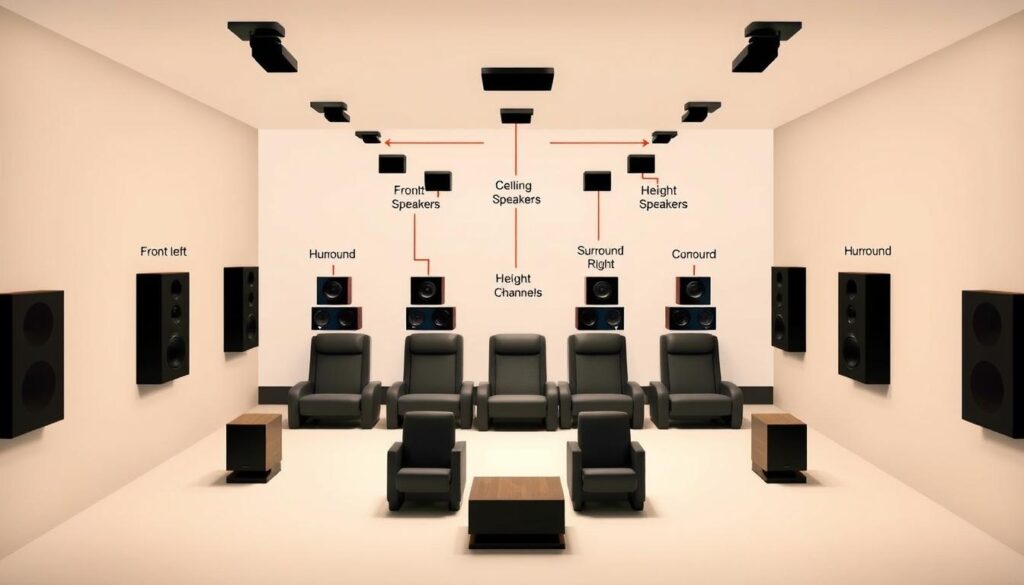
The numbers game: 5.1.4 means five ear-level speakers, one subwoofer, and four overheads. 7.1.4 adds two more surround channels. It’s like going from a black-and-white TV to IMAX 3D for your ears.
Where you place the speakers is more important than how much they cost. I’ve seen expensive systems sound bad because they were set up wrong. Someone thought ceiling speakers were just decorations.
Here’s the acoustic choreography:
- Front speakers create the stage
- Surrounds build the environment
- Overheads drop the sky on your head
- The subwoofer handles existential dread
Dolby Atmos turns sound effects into emotional experiences. That helicopter isn’t just flying overhead; it’s targeting your popcorn. The rain isn’t just noise; each drop hits your space exactly.
Getting it right means audio moves around you like a dance. It’s the difference between watching a storm and feeling it from your living room.
The magic happens when everything works together. Proper Dolby Atmos setup makes you forget you’re listening to speakers. You’re just in the scene. It’s less home theater and more a way to travel through time.
I always tell clients: your ears don’t care about the price. They care about the sound. Dolby Atmos done right doesn’t sound impressive; it feels like it was always meant to be this way.
This isn’t luxury; it’s the new standard for immersion. Once you experience Dolby Atmos right, regular surround sound feels like watching reality through a screen door.
Acoustic treatment: bass traps, diffusion, isolation
Most home theaters look great but sound like they’re in a tin can. Acoustic treatment changes that. It turns your space into a real cinema experience.
Bass frequencies are like unruly guests. They bounce around and mess up your sound. Bass traps keep them in check, placed in corners where bass energy gathers.
Diffusion is a hero of sound treatment. It spreads sound evenly, making dialogue clear and effects real. Without it, sound waves cluster, making your space sound odd.
Isolation keeps your sound private and pure. It keeps external noises out, letting your audio shine. It’s not just for neighbors; it’s for a better listening experience.
Without acoustic treatment, your expensive gear won’t reach its full sound. It’s like putting a Ferrari engine in a golf cart. Your room’s natural tendencies will hold it back.
| Treatment Type | Primary Function | Ideal Placement | Impact on Sound |
|---|---|---|---|
| Bass Traps | Control low frequencies | Room corners | Reduces muddiness |
| Diffusion Panels | Scatter sound waves | Side and rear walls | Enhances spaciousness |
| Absorption Panels | Reduce reflections | First reflection points | Improves clarity |
| Isolation Materials | Block sound transmission | Walls, ceiling, doors | Creates sonic separation |
With the right treatment, your sound changes dramatically. Whispers become intimate, explosions powerful, and music emotional. It’s not just tweaking; it’s mastering sound.
Your gear is only as good as your room’s treatment. It’s the key to making everything work together, not against each other.
Power, HVAC noise, and equipment racks
The difference between a pro installation and a hobby often lies in three key areas: power, climate control, and organizing your gear. These elements are the real heroes of your movie-watching experience.
First off, power is critical. Your equipment needs clean, stable power to avoid hums, buzzes, and AM radio interference. It’s like giving your system the best wine, not cheap drinks.
HVAC noise can sneak up on you and ruin a quiet scene. Properly isolating your HVAC system is essential. It’s what makes a home theater great, not just good.
Equipment racks are more than just hiding spots for your gear. They’re the heart of your system, needing military-grade organization and airflow. I’ve seen systems fail due to heat issues more than bad equipment choices.
Your gear gets hot, like a small sun. Without good airflow, you’re cooking your expensive electronics. A well-designed rack should have:
- Strategic ventilation front and rear
- Cable management that would make Marie Kondo proud
- Thermal monitoring systems
- Easy access for maintenance
This setup might not be glamorous, but it’s the backbone of your system. Get it right, and your system will shine like a Broadway show, not a high school play.
Lighting scenes: sconces, step lights, star ceilings
Forget what you know about light switches; in a proper home cinema, lighting is an art form. It’s like the film score, shaping the mood of the room. We’re not just turning lights on and off – we’re creating a dance of light and shadow.
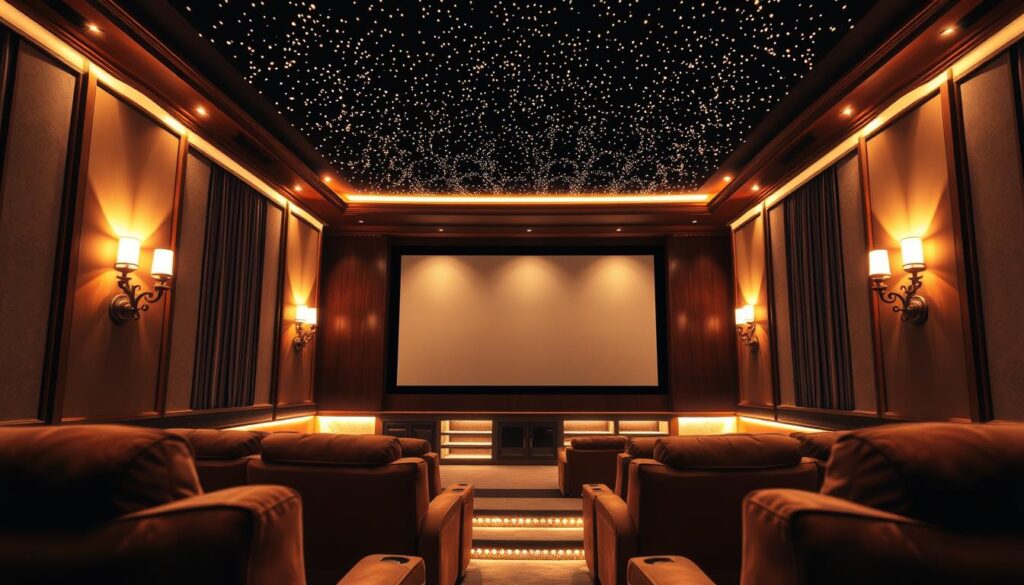
Wall sconces give off a warm glow, like stepping into a 1920s movie palace. They’re not just lights; they’re time machines with dimmer switches. The right sconce can add depth and dimension, something overhead lights can’t match.
Step lights blend safety with style. They guide you in without being too bright, like a discreet usher. When done right, they make entering your luxury home theater feel like a red carpet event.
The star ceiling is the crowning glory, turning your home into a celestial wonder. It’s not just decoration; it’s magic. I’ve seen adults get emotional when the star ceiling lights up.
When these elements work together, magic happens. A “pre-show mingling” setting might use sconces at 70% and step lights fully on. The “immersive experience” scene dims everything, letting the star ceiling shine.
This lighting dance makes the room disappear, leaving only the story. Your luxury home theater becomes a place where light tells the story. It’s not just watching a movie; it’s living the story in a space that changes with the tale.
Control: remotes, touchpanels, voice macros
Ever feel like you need an engineering degree just to watch Netflix? That’s where intelligent control systems come in. They turn your tech into a symphony, not a cacophony.
Let’s talk about remotes. Not the dozen clickers on your coffee table. I mean universal remotes that actually work. They make you wonder how you ever tolerated anything less.
Modern systems like Control4’s offerings have evolved. They’re not just simple button-pushers. They’re touchscreen command centers that adapt to whatever you’re watching. It’s like having a Swiss Army knife for your entertainment system.
Then there are touchpanels. They make complex technology easy for everyone in the household. Grandma can start her favorite show with two taps. The kids can’t accidentally turn your receiver into a paperweight. It’s user-friendly design that actually deserves the name.
But the real magic happens with voice macros. Say “Movie night” and watch the transformation: lights dim to precisely 15%, drapes close, projector warms up, and the amplifier switches to Atmos mode. It feels less like technology and more like witchcraft – and who doesn’t want to feel like a wizard in their own home?
The beauty lies in the integration. These systems don’t just control your gear – they understand how everything works together. They remember that you like subtitles on foreign films but not on comedies. They know to pause the movie when you get a phone call from your boss.
Here’s how the three control methods compare for different users:
| Control Method | Best For | Setup Complexity | Wife Acceptance Factor |
|---|---|---|---|
| Universal Remotes | Tech enthusiasts | Medium | Good |
| Touchpanels | Families | High | Excellent |
| Voice Macros | Everyone | High | Outstanding |
The goal isn’t complexity for its own sake. It’s simplicity through sophistication. A well-programmed control system should make you feel empowered, not overwhelmed. It’s the difference between conducting an orchestra and being buried in sheet music.
Good automation anticipates your needs before you articulate them. Great automation makes you wonder how you ever lived without it. And the best part? Once it’s set up, you’ll forget it’s even there – until you visit someone who’s stuck with remotes and subtitles in Portuguese.
Budget tiers and sample equipment lists
Money is a big deal when it comes to home theaters. I’ve seen systems that cost a lot and others that offer great value for less. It’s all about how you spend your money.
Creating a luxury home theater isn’t just about finding cheap stuff. It’s about making smart choices. Knowing where to splurge and where to save is key.
I’ve put together three budget tiers for home theaters. Each tier has its own approach, from budget-friendly to no-holds-barred.
The Three Budget Philosophies
Enthuasiast Elite ($15K-30K): This tier offers great value. You get top-notch performance without breaking the bank.
Reference Grade ($50K-100K): This is for serious fans. You’ll find quality acoustic treatment and components that really make a difference.
Statement System ($150K+): This tier is for those who don’t care about money. It’s all about achieving perfect sound without any limits.
| Tier | Video Solution | Audio Configuration | Acoustic Priority |
|---|---|---|---|
| Enthuasiast Elite | 4K Laser Projector + 120″ ALR Screen | 5.1.4 Dolby Atmos System | Bass traps + primary reflection points |
| Reference Grade | 8K Projector + 135″ Acoustic Screen | 7.2.4 Dolby Atmos System | Full absorption + diffusion treatment |
| Statement System | Dual 4K Projectors + 150″ Microperf | 9.2.6 Dolby Atmos System | Professional room tuning + isolation |
The secret is simple: a well-chosen mid-range system beats a fancy setup. It’s not about spending a lot, but spending wisely.
When planning your home theater room setup cost estimation, don’t forget about hidden costs. Things like acoustic panels, wiring, and calibration can greatly impact your budget.
The best system isn’t the most expensive. It’s the one that disappears when the lights go down. That’s where dreams meet reality, and smart choices create amazing experiences.
Commissioning tests and demo playlist
This is where your home theater stops being a theory and becomes a reality. Commissioning isn’t just paperwork—it’s the scientific method applied to entertainment. I use specific demo content that reveals everything from color accuracy to bass response.
Your demo playlist should be a greatest hits of technical challenges. Scenes that test dynamic range, dialogue clarity, and surround imaging. This is where you discover if your seating rake provides the intended sight lines or if your projector vs microLED choice delivers the promised contrast.
Proper acoustic treatment gets its final exam here. Bass traps either work or they don’t. Diffusion either creates space or chaos. Your demo content doesn’t lie—it reveals the truth about every investment you’ve made.
Commissioning turns a collection of components into a cohesive experience. This isn’t the end—it’s the beginning of your relationship with perfection. Now press play and let the science begin.