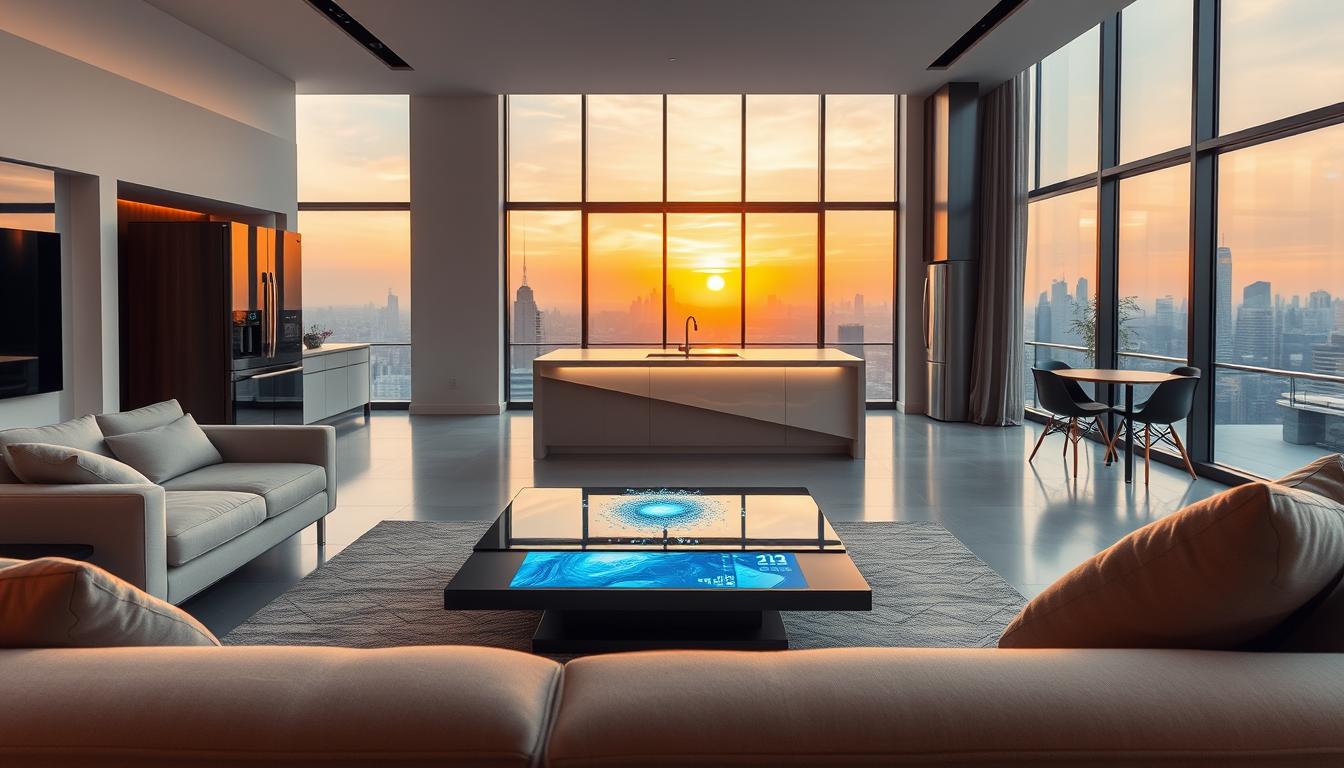
Ever walked into a stunning room and seen a clunky gadget ruining it? I had that moment when my living room looked like a Star Trek set. It made me realize: true beauty means your fancy home should look good and work well.
This guide is for those who love both beauty and new tech. You’re the ones who want your smart home tech to be hidden, not in your face. No one wants their fancy house to look like a big-box store.
We’re focusing on design-first thinking. It’s about tech that fits in, not takes over. Imagine Louis XIV’s Versailles with smart home tech—it would be perfect and seamless.
Your home should be more than just gadgets and wires. It should be smart and stylish. Your sanctuary deserves the best.
Core Platform Choices and Open Standards
Welcome to the smart home platform showroom. Here, Savant, Crestron, and Control4 are like Mercedes, BMW, and Audi. Each has its own fans and unique approach to automation.
Savant works like Apple’s ecosystem. It’s beautifully designed and easy to use. It feels like something Jony Ive would love, with everything working together smoothly.
Crestron is like a custom tailor. They create solutions that fit you perfectly, no matter the cost. It’s for those who want everything just right.
Control4 is the reliable Swiss watch of the group. It may not look flashy, but it’s always on time. It offers solid performance without breaking the bank.
Now, let’s talk about the shift in smart home tech. Proprietary systems are like medieval fiefdoms in today’s world of open borders.
Matter is like the smart home’s constitution. It aims to unite devices from different brands. No more fights between your lights and thermostat.
Thread acts as the diplomatic corps for your devices. It creates mesh networks for reliable communication. It’s like having ambassadors in every room.
KNX is the European aristocrat of wiring standards. While Matter and Thread focus on wireless, KNX provides a wired backbone. It’s the timeless choice for serious automation.
Blending these approaches is the real magic. A Crestron system with Matter compatibility is like a custom suit with modern flexibility.
Your choice depends on what you value most. Do you want seamless integration, custom perfection, or reliable simplicity? Open standards ensure your investment stays relevant.
Think of it this way: proprietary platforms are like mansions, but open standards make sure all rooms connect. You wouldn’t build a palace with doors that only open one way, would you?
Must‑have categories: lighting, climate, shades, audio, security, access, sensors
I learned the hard way that skipping even one of these categories can turn your smart home into an expensive collection of disconnected toys. A client’s rare book collection nearly ruined because I considered environmental sensors optional. That humid summer taught me that true high-end home automation isn’t about having the most gadgets—it’s about covering your essentials like a strategic chess master.
Lighting control separates the amateurs from the professionals. It’s not just about dimming bulbs; it’s about painting with light. Good lighting creates emotional landscapes that shift with your day. Morning scenes energize. Evening scenes relax. It’s the difference between living in a home and experiencing a environment.
Climate control should work like an invisible butler—always present, never noticed. The system learns your preferences and adjusts seamlessly. No more fighting over the thermostat. Your home breathes with you, maintaining perfect comfort while saving energy. It’s climate intelligence that feels like magic.
Motorized shades are the unsung heroes of energy efficiency and privacy. They automatically adjust throughout the day, blocking harsh sun in summer and inviting warmth in winter. With a single command, your entire home can shift from open and airy to private and cozy. They pay for themselves in energy savings within seasons.
Whole-home audio deserves the symphony orchestra comparison. Each room becomes a different instrument section. The kitchen might play upbeat jazz while the study enjoys classical. The system balances itself perfectly, following you through the house without missing a beat. No more Bluetooth speakers fighting for connection.
Security and access systems get the James Bond treatment they deserve. Smart locks recognize authorized users while keeping intruders out. Cameras provide crystal-clear monitoring without becoming eyesores. The system sends intelligent alerts—not every leaf blowing by, but actual threats. It’s security that protects without paranoia.
Environmental sensors act as your home’s nervous system. They detect humidity, temperature, air quality, and even water leaks. That book collection disaster? Never again. Now sensors alert me before damage occurs. They’re the silent guardians that prevent thousands in repairs.
Access control might sound corporate, but in homes, it’s about graceful living. Smart locks that recognize family members. Garage doors that open automatically as you approach. Gates that welcome guests while keeping others out. It’s the art of making security feel effortless and invisible.
| Category | Primary Function | Luxury Benefit | ROI Timeline |
|---|---|---|---|
| Lighting Control | Mood creation & energy savings | Emotional ambiance tailoring | 2-3 years |
| Climate Management | Temperature optimization | Invisible comfort maintenance | 3-4 years |
| Motorized Shades | Light & privacy control | Automated environment adjustment | 2-3 years |
| Whole-home Audio | Immersive sound experience | Seamless audio continuity | 4-5 years |
| Security Systems | Property protection | Intelligent threat detection | Immediate |
| Access Control | Entry management | Frictionless accessibility | 1-2 years |
| Environmental Sensors | Risk prevention | Proactive damage avoidance | Immediate |
These seven categories form the foundation of any serious high-end home automation system. They work together like a well-trained staff—each performing their role while contributing to the whole experience. Skip one, and you’ll notice the gap immediately. Include them all, and you’ve created not just a smart home, but an intelligent living environment.
Design-forward devices: architectural speakers, invisible panels, trimless keypads
I once saw a home that looked perfect. It had clean lines and a minimalist style. But then, I saw the ugly keypads on the walls. They looked like they didn’t belong.
Real luxury smart home tech is subtle. It doesn’t shout for attention. It follows Mies van der Rohe’s rule: less is more. Here’s how to hide your tech while keeping its power.
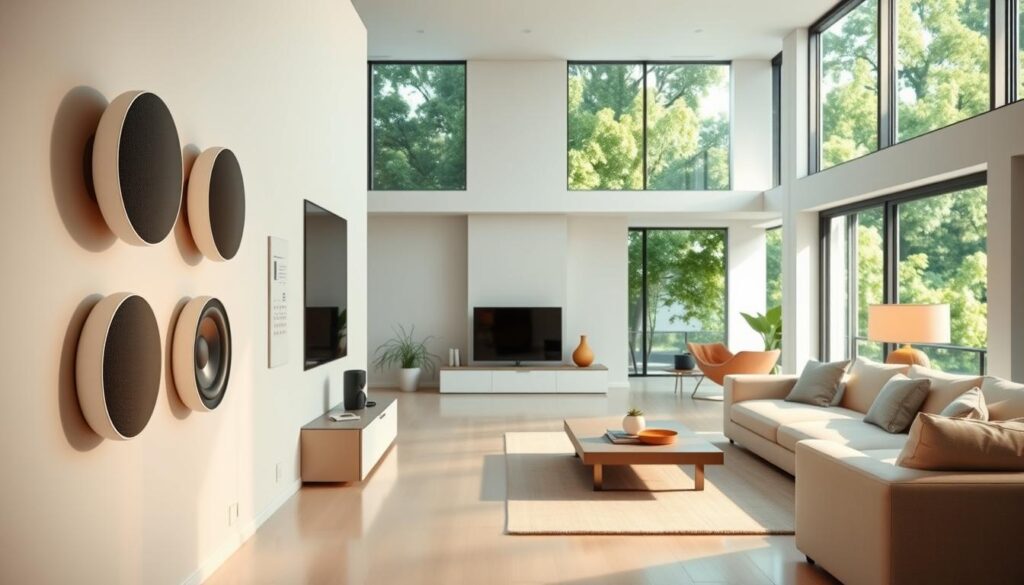
Why have speakers that stick out when you can have sound that seems to come from the walls? Architectural speakers blend into your ceiling. They’re like secret agents – you won’t see them, but you’ll feel their power.
These aren’t old-school speakers. They have special features like paintable grilles and magnetic mounts. They even sound better than concert halls. The best ones fit perfectly, making your walls sound like speakers.
Invisible Panels: Houdini Would Be Proud
Remember when touchscreens were just black mirrors on walls? Those days are gone. Now, invisible panels blend in until you need them. They turn countertops and mirrors into screens and control centers.
The magic is in:
- Retractable mechanisms that pop out when needed
- E-ink tech that disappears when not in use
- Projection systems that make any surface interactive
It’s tech that knows its place – which is to be invisible.
Trimless Keypads: The Bauhaus Dream
Trimless keypads are so minimalist, they’re almost like ideas. They fit right into your walls, with no visible edges. They even have haptic feedback and finishes that match your paint.
The best ones have:
- Touch surfaces that work without moving parts
- LED indicators that hide when not in use
- Finishes that resist fingerprints
They’re so sleek, you might forget they’re there. But when you need them, they control your whole home.
| Device Type | Visual Impact | Installation Complexity | Cost Premium |
|---|---|---|---|
| Architectural Speakers | Minimal | Moderate | 20-40% |
| Invisible Panels | None when off | High | 50-100% |
| Trimless Keypads | Minimal | Low | 15-30% |
The more you spend on invisible tech, the more your home is worth. It’s a design paradox. Visible tech is like old shag carpet. Nobody wants that.
Scene Design for Daily Rituals
Forget about flipping switches. True home automation is about choreographing experiences. It turns daily routines into theatrical performances. Why settle for turning on lights when you can stage-manage your entire existence?
My favorite programming moment was when a client asked for a “goodnight” scene like Shakespeare’s tragic heroes. The result? Lights dim to 1% over 12 minutes while “Parting is such sweet sorrow” plays softly. The toilet seat even warms itself for one last moment of comfort. Talk about dramatic exits.
Morning rituals deserve Marie Kondo-level precision. The perfect wake-up sequence doesn’t just open blinds—it orchestrates a sensory awakening:
- Bedroom lights simulate sunrise 15 minutes before alarm
- Kitcent coffee begins brewing as bathroom floor warms
- News briefings play softly while shower reaches perfect temperature
Arrival scenes should feel like a five-star hotel welcome. My standard programming includes entryway lights fading up gradually, thermostat adjusting to preferred temperature, and favorite music playing in the distance. It’s the domestic equivalent of a red carpet—minus the paparazzi.
Entertainment modes transform living spaces into performance venues. With one button press: motorized shades descend, projector screens drop, and lighting shifts to theater presets. The only thing missing is popcorn service—though I’ve programmed that for clients with snack drawers.
These ritualized interactions matter more than any tech specification. They create emotional connections to technology. When your house practically tucks you in at night, you’re not just living with automation—you’re participating in a daily production where you’re both audience and star.
App, keypad, and voice control hierarchy
Control interfaces are like political parties in your smart home. Each has its own platform, policies, and followers. If you mix them up, it’s like a cabinet where everyone talks at once while the president scrolls through TikTok.
Your smartphone app is like the legislative branch. It’s where you make detailed plans for your home – like setting lighting scenes for dinner or creating security protocols. The app handles the complex legislation of your smart home.
Keypads are like your executive orders. With one button press, you can change everything – like turning off everything or activating a scene. These are your emergency powers made physical.
Voice control is like pure democracy. Anyone can ask for changes – like “Hey Google, make it brighter” or “Alexa, I’m cold.” It’s easy to use but not always precise, like popular referendums.
The psychology behind this hierarchy shows why luxury feels luxurious. Using phone menus is like bureaucratic red tape, while physical buttons give instant satisfaction. Voice commands are convenient but lack the ceremony of deliberate control.
Watching someone struggle with a bad app is like congressional gridlock – all procedure and no progress. But a well-placed keypad gives instant gratification without the paperwork.
| Control Method | Best Use Case | Limitations | Political Analogies |
|---|---|---|---|
| Smartphone App | Detailed programming and system management | Requires attention and navigation | Legislative branch – creates laws |
| Wall Keypads | Instant scene activation and overrides | Fixed locations and functions | Executive orders – immediate action |
| Voice Control | Hands-free convenience and casual commands | Ambient noise sensitivity and privacy concerns | Direct democracy – popular input |
| Touch Panels | Rich graphical interface and status monitoring | Higher cost and complexity | Judicial branch – interprets and displays |
The magic happens when these systems work together. Keypads handle daily routines, while voice manages spontaneous requests. The app is for deep changes – the constitutional conventions of your smart home nation.
This hierarchical approach turns technology into enchantment. When systems anticipate needs, you get that luxury feeling: control without effort, power without paperwork, and magic automation.
Network and power fundamentals for reliability
Imagine your fancy smart home turning into a simple box because of bad network setup. It’s a disaster that even Shakespeare would write about.
A top-notch automation system is useless if it can’t stay connected. I’ve seen more smart home failures due to bad networking than any design issue. It’s a silent killer that turns luxury into frustration.
Your network infrastructure is the unsung hero of home automation. While everyone focuses on touch panels and voice control, the Ethernet cables in your walls do the real work. They’re like the stage crew behind the stars.
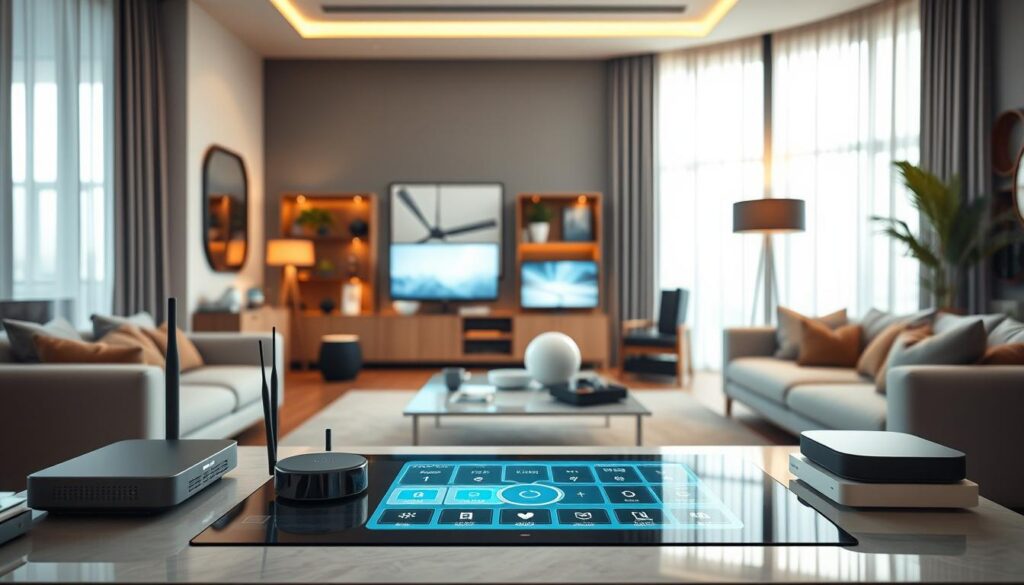
Think of it like Swiss trains versus budget airlines. Swiss trains run smoothly, while budget airlines are unpredictable. Your smart home should run like Swiss trains, not like budget airlines.
Power reliability is also key. Those fancy keypads and hidden speakers need steady electricity. Nothing kills the luxury vibe faster than devices rebooting during your dinner party.
Here’s what makes pro installations better than DIY ones:
- Dedicated network switches for automation systems
- Proper UPS (uninterruptible power supply) units
- Commercial-grade Wi-Fi access points
- Redundant internet connections
- Quality cable management throughout
I’ve seen Wi-Fi issues that would make an IT pro cry. Thirty devices fighting over a consumer router? That’s not smart home living – it’s digital torture.
Invest in proper network infrastructure early. It’s cheaper than fixing it later when your system fails. Your future self will thank you for a smooth-running system.
Power matters just as much. Brownouts, surges, and dirty electricity can harm your expensive gear. Good surge protection is a must – it’s insurance for your big investment.
Remember: foundations matter. Nobody notices the foundation until the building collapses. Don’t let your smart home become that cautionary tale.
Budget tiers and where to splurge vs save
Let’s talk about money without feeling awkward. Budgeting for smart home tech is like a chef planning meals. Every dollar must have a purpose.
Think of your smart home budget like an investment portfolio. You wouldn’t put all your retirement money into fancy stocks. Don’t make that mistake with your home automation.
Your foundation needs the best. Splurge on infrastructure – the hidden heroes. Network systems, controllers, and wiring are like a solid financial foundation. They’re boring until they fail, and then they become very expensive.
On the other hand, save on endpoints – the visible gadgets. Fancy touchscreens and decorative controllers are like luxury handbags. They look good but won’t save you when your network crashes.
Here’s my personal manifesto developed through years of watching clients regret their choices:
| Category | Splurge Recommendation | Save Strategy | ROI Analysis |
|---|---|---|---|
| Network Infrastructure | Enterprise-grade switches | Basic consumer routers | High reliability payoff |
| Control System | Professional controllers | DIY solutions | Essential for integration |
| Lighting Controls | System-compatible dimmers | Standalone smart bulbs | Long-term durability |
| User Interfaces | Key architectural keypads | Secondary touchscreens | Strategic placement matters |
| Audio Equipment | Quality amplifiers | Fancy speaker finishes | Performance over aesthetics |
The champagne taste on a beer budget never works. I’ve seen clients spend $500 on touchscreens but use cheap network equipment. It’s like putting Pirelli tires on a bicycle.
Prioritize reliability over flash. Your future self will thank you when the system works flawlessly for years. The hidden infrastructure is where true luxury lives – even if nobody sees it at dinner parties.
Remember: splurge on what makes the system work, save on what makes it pretty. That’s how you build a smart home that actually works smart, not just looks smart.
Commissioning, maintenance, and software updates
The idea of ‘set it and forget it’ technology doesn’t last long. A $100,000 smart home system can crash during a dinner party. Luxury automation needs constant care to work right.
Commissioning is more than just setting up. It’s like hiring a conductor for a symphony. Every device must work together perfectly from the start. Skipping this step is like building on shaky ground.
Maintenance should be as regular as car service, not dentist visits. Regular checks prevent big problems. I’ve seen systems so neglected, they’re like the Titanic’s maintenance log.
Proactive care is much cheaper than fixing things later.
Software updates are like changing your wardrobe seasonally. They keep your system looking good and working right. Not updating is like wearing old clothes—it’s outdated and not secure.
Many owners don’t budget for luxury tech’s hidden costs. Plan to spend 15-20% of your system’s cost each year on upkeep. This is necessary for keeping your home up-to-date.
Your smart home needs expert care, not DIY.
For seamless tech, get professional commissioning support. It makes complex tech easy to use. Your smart home should be hassle-free, not a headache.
Technology is like milk, not wine—it gets old fast. Regular updates keep your investment in top shape. The best smart homes are those you don’t have to think about.
Future-ready considerations and upgrade paths
Today’s tech becomes outdated quickly, like how flip phones are now relics. In smart homes, staying ahead is essential. Your system should grow and adapt like a chess master.
Wireless protocols like Zigbee and Z-Wave are key. They make sure all your devices can communicate. Think of them as translators, keeping your gadgets useful for years.
Choosing the right upgrade path is critical. That shiny control panel might soon be outdated. Opt for systems with strong developer support and backward compatibility. Your smart home should improve with time, not become obsolete.
Future homes will anticipate your needs before you even ask. The real luxury is having tech that evolves with you. This approach ensures your home meets your needs today and tomorrow.