Smart remodeling trends look more practical than speculative in the 2026 renovation market. The Remodeling Market Index still pointed to expansion in Q2 2026, but the signals were not equally strong across project sizes or future demand. For homeowners, that means smart-home upgrades should be planned as part of repair, safety, comfort and daily-use decisions rather than treated as add-ons that automatically justify a larger remodel.
The Q2 2026 Remodeling Market Index stood at 61, one point below Q1 and above the 50 threshold that separates expansion from contraction. Its Current Conditions Index was stronger at 70, with small projects under $20,000 at 74, moderate projects from $20,000 to $49,999 at 73, and large projects of $50,000 or more at 64. Future Indicators were lower at 52, with backlogs at 54 and leads and inquiries at 51. That mix suggests active remodelers still had work, but homeowners were showing more caution about what to start next.
What Smart Remodeling Trends Mean In 2026
Smart Remodeling Trends And Project Size
The strongest RMI readings came from smaller and moderate projects. That matters because many smart-home improvements fit those scopes better than whole-house rebuilds. A doorbell camera, smart lock, smart garage door opener, indoor security camera or selected lighting control can often be evaluated room by room or entry by entry. That does not mean installation is always simple, but it does mean the planning decision can be smaller and more measurable.
Smart remodeling trends also need to be judged against broader spending patterns. The Joint Center for Housing Studies reported that annual homeowner spending on improvements and maintenance was expected to reach $518 billion by the end of 2026, while growth was projected to slow from about 2.1% around mid-2026 to about 1.6% by year-end, according to the Harvard LIRA release. In practical terms, the market was not collapsing, but homeowners had reason to question scope creep.
That slower growth setting supports a repair-first mindset. If a remodel already includes a new entry door, a garage update, better exterior lighting or low-voltage planning, it may be sensible to compare smart and standard options. If the only reason to open walls or expand electrical work is to chase a new feature, the cost and disruption deserve a harder review.
Reading The RMI Before You Choose Devices
Current Demand Is Not The Same As A Personal Need
The RMI is useful because it separates current conditions from future indicators, but it should not be read as a personal green light for every upgrade. A 61 reading means remodelers reported expansion on balance in Q2 2026. It does not say that every smart device will pay off, work with every home, or remain supported by a manufacturer for as long as a cabinet, roof or floor.
Homeowners can use the index as a timing tool. If remodelers remain busy, bids may take longer and scheduling may be less flexible. If future indicators are softer, some contractors may be more open to smaller, tightly defined jobs. Either way, a smart-home plan should be written before pricing starts: which openings need monitoring, which users need access, where Wi-Fi coverage is reliable, and which features can be skipped without affecting daily function.
Houzz’s 2026 U.S. Houzz & Home Study reported that 54% of U.S. homeowners completed renovation projects in 2025, while median renovation spend held at $20,000. It also reported that 50% planned renovations for 2026, down from 52% in 2025, with planned median spend at $15,000, according to the Houzz renovation study. That planned-spending decline is a useful caution: smart remodeling trends are not a reason to add every connected feature at once.
Budgeting Smart Features Within A Slower Market
Spend Where The Remodel Already Creates Access
For budget planning, smart remodeling trends work best when they align with work already being done. A kitchen remodel may be a logical time to think about lighting controls and outlet placement, but hardwired work should be handled by qualified electrical professionals. An exterior project may be a logical time to compare standard and smart security-related products, but camera placement should respect privacy, weather exposure, power access and the home’s network limits.
The 2026 Houzz research noted that among homeowners who renovated in 2025, 14% chose smart wireless doorbell cameras and 9% chose smart indoor security cameras. Smart garage door openers and wireless smart locks were also ahead of their standard counterparts in the reported shares. Those figures point to selective adoption, not universal conversion.
- Define the problem first. Package theft, guest access, nighttime visibility and aging-in-place concerns call for different products.
- Separate device cost from project cost. A low device price can still involve labor, network upgrades, patching, permits or a service plan.
- Check compatibility before demolition. Door thickness, lock type, garage opener age, chime wiring and Wi-Fi strength can affect product choice.
- Keep manual operation in mind. Entry, garage and lighting systems should still make sense during outages or app problems.
If a homeowner is splitting safe DIY tasks from professional work, a phased approach may control cost better than bundling every idea into one contract. For a related planning framework, see this article on hybrid renovation for smarter home projects.
Safety Boundaries For Smart Home Remodels
Know Which Work Is Not A DIY Task
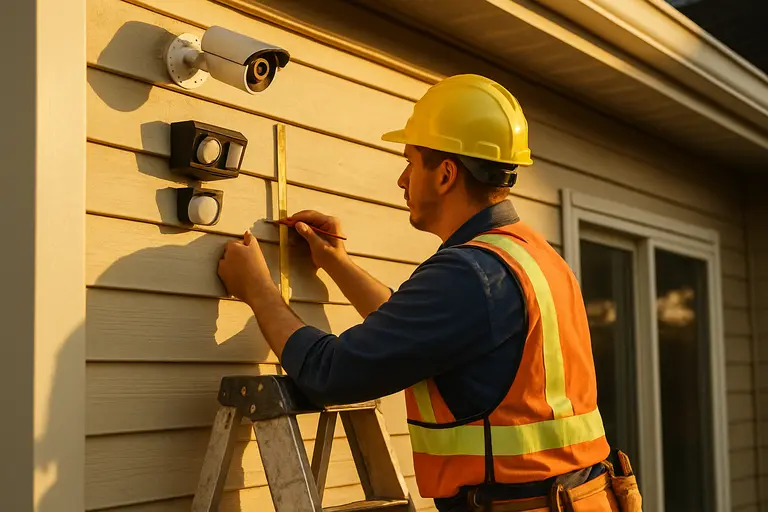
Reading smart remodeling trends should not blur safety limits. Plug-in devices and app setup are very different from opening electrical boxes, altering exterior penetrations, replacing garage door components or changing a lock on a required exit door. Homeowners should use licensed trades where local rules, electrical work, structural attachment, garage door systems or life-safety concerns are involved.
Security products also deserve a privacy review. A camera that records a driveway, front walk or side yard may affect neighbors, guests and service workers. The practical step is not to avoid cameras entirely; it is to choose only the coverage needed, set user permissions carefully, and document who can access the system. Those choices should be made before devices are mounted, not after footage begins collecting.
Network reliability is another limit that gets overlooked. A smart lock, camera or garage device depends on power, software and connectivity. If the home has weak Wi-Fi at the entry, detached garage or patio, the remodel budget may need network planning before more devices are purchased. In some homes, a standard fixture or lock may be the safer and less frustrating choice.
For readers seeking local insights into renovation decisions, visiting Jimmy Guthrie Real Estate LLC might offer a valuable perspective. However, selecting products should always be based on individual household needs, safety considerations, and the current state of the property.
Remodeling Market Index For Smart Home Projects
Use The Index As A Planning Signal
The Remodeling Market Index is most helpful when treated as a planning signal rather than a forecast for one household. In Q2 2026, it showed remodeling activity above contraction levels, strong current conditions, and softer forward-looking demand. That is a good match for a cautious smart-home strategy: prioritize smaller projects with clear benefits, avoid opening finished spaces without a strong reason, and ask contractors to price smart and standard options separately.
For homeowners planning work before the end of 2026, the practical question is not whether connected products are popular. The question is whether a specific feature solves a real problem at a cost, risk level and maintenance burden the household accepts. The best use of smart remodeling trends is to narrow the scope, not widen it without evidence.
A sound smart remodel starts with the same fundamentals as any good renovation: safe systems, clear access, durable materials, realistic scheduling and qualified labor for risky work. Smart devices can support those goals, but they should not replace them.