I once worked with a client who loved caviar but had a tuna salad budget. She wanted her home to say “old money” but her bank account was saying “new anxiety.” This is the modern dilemma, isn’t it?
True luxury isn’t about spending too much. It’s about strategic allocation of resources. Think of it like a political campaign: you need to know where to spend big and where a clever tweet will do.
So, how do you spend big where it matters and save where it doesn’t? The goal is a home that tells a rich story, not one that looks cheap.
We’re all about “quiet luxury” aesthetics. But let’s be honest. That look often needs big spending. The real art is affording the illusion through smart choices and value prioritization.
Your home is a story. Every purchase is a plot point. Let’s write a better story.
Define value impact per square foot versus daily touch points
The most elegant form of value engineering starts with a simple question: ‘Who gets the most screen time in this house?’
Don’t spread your budget evenly across square footage. That’s basic. True luxury design is about choosing your home’s features like a director picks actors for a blockbuster.
Now, let’s introduce two new ways to think: Value Impact Per Square Foot (VIPSF) and Daily Touch Points (DTP).
VIPSF is about the wow factor per space. A dramatic marble wall in a small foyer has a high VIPSF. It makes a big, immediate statement.
DTP looks at how often you interact with something. Your kitchen sink, which you lean against daily, has a high DTP score. It’s a supporting actor with more screen time than the lead in a Terrence Malick film.
The magic happens where VIPSF and DTP meet. Is that $10,000 marble slab in a guest powder room worth it? VIPSF says yes, but DTP says no, it’s used only twice a year.
Let’s look at some common features through this lens. The results might surprise you.
| Home Feature | Daily Touch Points (DTP) Analysis | VIPSF Logic | The Verdict |
|---|---|---|---|
| Kitchen Countertop | Extreme. You prep, eat, work, and lean here daily. It’s a tactile, functional workhorse. | Moderate. It’s a large, continuous surface, so its visual impact is spread thin. | Splurge. High DTP wins. Durability, feel, and function are key. |
| Guest Bathroom Floor Tile | Very Low. Guests use it infrequently. You barely see it. | Can be High. A small room means bold pattern has big visual punch. | Save Smart. Favor VIPSF here with a great lookalike tile. No one will scrutinize it. |
| Formal Dining Room Wall Treatment | Low. It sets a mood for occasional dinners. It’s atmosphere, not interaction. | Potentially Very High. Walls are the room’s canvas. Dramatic treatment defines the space. | It depends. If you host often, splurge for VIPSF. If not, a bold paint color achieves similar impact for less. |
This framework helps you prioritize fixed elements in high-traffic zones. Your primary bath faucet (high DTP) deserves more investment than the chandelier in a spare bedroom (high VIPSF, low DTP).
It’s not about being cheap. It’s about being strategic. You allocate big bucks to elements you interact with often. That’s how you master the true cost per impact of a luxurious home.
High impact splurges kitchens primary baths glazing and stair moments
Some parts of your house need a blank check. This is because their impact is huge, both in size and feeling. Think of it as investing in the best version of your home, not a quick fix you’ll regret.
The kitchen is the star of your home. Spend big on it like it’s the main actor’s salary. Get solid cabinetry, stone countertops, and durable flooring. Cheap choices will leave you with a disappointing result.
Your primary bath is your own spa. It’s a must-have sanctuary. Spend on materials that handle steam and keep you calm. A solid shower surround and waterproof flooring are key. Quality fixtures make a big difference.
Windows are your home’s eyes. Good glazing is like high-definition TV. Don’t skimp on windows. They save energy, reduce noise, and keep drafts out. Bad windows cost you money and comfort. Good ones are a smart investment.
The staircase is your home’s highlight. It’s the first thing you see and guides your life. A cheap stair looks like an apartment. A quality one says “home.” It’s a statement that lasts forever.
Investing in these areas is smart. It’s not just spending money. It’s a long-term gain. A good floor, windows, and a kitchen that works well are worth it. You’ll feel the joy every day.
| Splurge Area | Key Investment | Lifecycle Cost Payoff | Hard to Change Later? |
|---|---|---|---|
| Kitchen | Solid cabinetry, stone countertops, durable flooring | High durability, daily utility, major resale value increase | Yes, very high cost & disruption |
| Primary Bath | Waterproof systems, solid-surface showers, quality fixtures | Long-term moisture resistance, creates a lasting personal sanctuary | Yes, plumbing and waterproofing are invasive to redo |
| Glazing (Windows) | Energy-efficient window package with quality seals | Lower utility bills, increased comfort, preserves the view | Yes, full replacement is a major project |
| Staircase | Solid construction, premium materials (wood, metal) | Architectural impact, safety, defines home’s flow and style | Yes, structural and highly disruptive to modify |
Where does your budget go? It goes to the parts of your home you live in every day. It’s a choice in the materials hierarchy. You’re not just buying things. You’re buying durability, efficiency, and a feeling. That’s the real lifecycle cost calculus: spending more now to save more later.
Save smart secondary baths utility areas paint over paneling tricks
Why should your guest bath cost as much as your primary? It shouldn’t. The magic happens in supporting spaces where looks matter more than luxury. Think of it like a movie: your kitchen is the star, but the laundry room can be a scene-stealer with the right look.
Value engineering is all about smart choices that save money. A secondary bathroom is perfect for a clever fake-out. Instead of expensive stone walls, use bold, floor-to-ceiling tiles. This saves money but looks amazing. It’s like a movie set designer’s trick for your home.
The smartest move is to plan bid alternates from the start. Work with your designer to have a budget-friendly Plan B ready. This turns budget worries into easy choices. No stress, just smart planning.
Paint is a game-changer. The “paint over paneling” trick is a classic for a reason. A few coats of paint can turn old paneling into something new and interesting. It’s a cheap way to add character. This is value engineering at its best.
Think the same way about other areas. Why spend on custom millwork in the laundry room? A coat of paint on IKEA cabinets can look just as good. Add solid brass pulls from a good online source, and you’ve got a high-end look without the high price. This is using those pre-planned bid alternates wisely.
The idea is simple: save custom iron for the main staircase. For the back hallway, a well-chosen, off-the-shelf solution with perfect paint works great. Your wallet and future self will appreciate it. Being smart with money beats spending it every time.
Material swaps lookalike stone porcelain slabs engineered woods
In the world of home finishes, today’s porcelain slabs are like Meryl Streep. They blend into any setting. This isn’t about cutting corners. It’s about using your budget wisely.
Why choose expensive marble when a lookalike can do the job for less? This way, you get more bang for your buck.
Let’s play a game of “Spot the Impostor.” The goal is to use materials smartly, not to deceive. You choose the real deal where it counts and use lookalikes elsewhere.
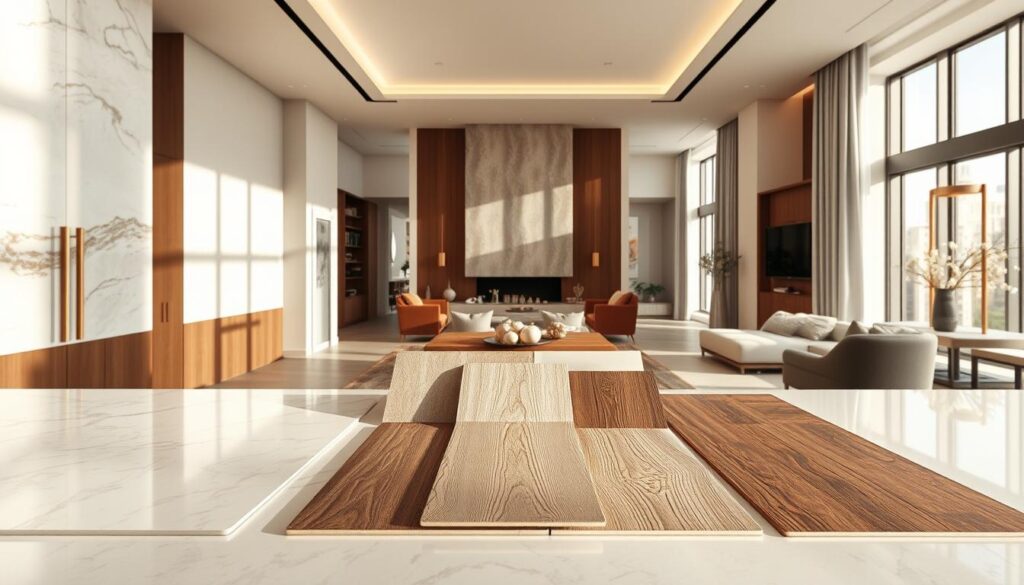
Porcelain slabs have come a long way. They used to be just for grandma’s bathroom. Now, they mimic high-end stones like Calacatta Gold or Nero Marquina. They’re affordable and durable, making them a smart choice.
Engineered wood is another great swap. It looks and feels like solid hardwood but is more stable. This means less warping and gaps, even with changes in humidity. Saving $15 per square foot is a big plus.
Quartz composites are also a smart choice. They mimic marble and other stones without the upkeep. In busy areas, they’re a practical and cost-effective option.
So, how do you decide where to splurge and where to save? It’s all about visibility, use, and cost. The table below shows the top contenders.
| Material Category | Prime Lookalike | Avg. Cost/SqFt (Lookalike) | Impact Quotient | Best Use Case |
|---|---|---|---|---|
| Natural Stone (e.g., Marble) | Quartz Composite | $60 – $100 | High | Kitchen islands, primary bath vanities |
| Solid Hardwood Flooring | Engineered Wood Plank | $8 – $15 | Very High | Living areas, bedrooms, hallways |
| Full-Slab Stone (e.g., Granite) | Porcelain Slab | $25 – $50 | Extreme | Statement walls, shower surrounds, countertops |
| Custom Wood Paneling | High-Pressure Laminate | $5 – $12 | Medium | Utility rooms, home offices, built-in interiors |
The highest impact quotients are for areas you see and use every day. A porcelain slab shower wall looks as luxurious as stone. An engineered wood floor in the living room is just as good as solid hardwood. The savings are real and smart.
This approach is key to a smart materials hierarchy. You’re not just building a set. You’re creating a home that looks great, works well, and saves money. The difference between “real” and “right” is what makes a design truly smart.
Lighting plan spend on layers architecture over decorative multiples
Many people treat lighting like jewelry in luxury design, but it should be seen as architecture. The flashy pendant is like an earring, and the sculptural floor lamp is like a necklace. They’re beautiful, but they’re accessories. The real structure of your home’s look is built from light you often don’t see. This is where smart budgeting becomes an act of cinematic direction.
Think of your home as a film set. Amateurs use one spotlight. Pros build a scene with three distinct layers:
- Ambient Light: This is your key light. It’s the general, even illumination that fills the room, like sunlight through a window or light reflected off a ceiling.
- Task Light: This is your fill light. It’s focused and functional, illuminating specific activities like reading, cooking, or applying makeup.
- Accent Light: This is your backlight. It creates drama and depth, highlighting artwork, architectural features, or a textured wall.
Where should you splurge? On the systems that create these layers seamlessly. This is value engineering for mood and function. Invest in architectural lighting: discreet cove lights that wash walls with a soft glow, perfectly placed and high-quality recessed cans, and a robust, whole-home dimming system. These elements work tirelessly, unseen, to shape space and emotion. They are the permanent crew of your production.
Conversely, where can you save? On the decorative “multiples.” You don’t need a forest of nearly identical trendy pendant lights over your kitchen island. One stunning, well-chosen piece often has more impact than a costly collection. The same goes for sconces. Their shape is a fleeting trend; the quality of light they emit is not.
This leads directly to the lifecycle cost analysis. Splurge on advanced, high-CRI LED modules for your architectural fixtures. The technology is long-lasting and energy-efficient. Save on the decorative fixture itself—you can replace the “pretty” part in a decade without rewiring your entire budget breakdown for interior design. The goal is permanence in the system and flexibility in the style.
Good lighting doesn’t shout. It reveals. It is the sage’s tool, uncovering the truth of your materials and the beauty of your proportions. Spend on the silent, intelligent layers. Let the decorative pieces be the punctuation, not the entire sentence.
Hardware and plumbing prioritize touch and function over brand hype
Let’s get tactile: the difference between a luxury faucet and its affordable twin often lives in your fingertips, not on the price tag. I’ve toured the factories. Here’s the insider secret you deserve: that $1,200 branded marvel and the $400 “lookalike” frequently roll off the same assembly line, separated only by a logo stamp and a marketing budget. The real luxury isn’t the name; it’s the silent drain, the perfect heft of a lever, and a spray pattern that feels like rainfall.
This is where your materials hierarchy meets daily ritual. Don’t just spec from a catalog. You must feel the weight. Test the spray. Listen for the absence of sound when water disappears. Function is the ultimate form of luxury. A cheap faucet feels hollow and chatters. A good one has a substantive, smooth action. It’s a quiet testament to quality.
So, how do you spend wisely? Become a finish mixologist. My go-to strategy: appoint a single “hero” fixture. In the primary bath, this is your polished nickel or unlacquered brass moment—a piece of jewelry for the room. Then, specify elegant, reliable black or chrome fixtures elsewhere. This contrast creates depth and sophistication, not monotony.
This approach is the core of smart bid alternates. You give your contractor clear A/B options. Option A might be the hero faucet in the primary suite with supporting black fixtures in secondary baths. Option B could flip the finishes. This controls costs without sacrificing the overall aesthetic vision, a principle central to any design first principles approach.
The table below breaks down this mixologist strategy room by room. It’s your cheat sheet for balancing splurge and save.
| Room | Hero Fixture (Splurge) | Supporting Fixture (Save) | Finish Mix Rationale |
|---|---|---|---|
| Primary Bath | Wall-mounted faucet in polished nickel | Shower trim in matte black | Focal point on the vanity; black adds modern contrast and is cost-effective for wet areas. |
| Kitchen | Professional-style pull-down faucet | Standard bar/prep faucet | Invest in the workhorse you touch daily; a simpler secondary faucet handles utility tasks. |
| Secondary Bath | Statement mirror or light fixture | Reliable widespread faucet in black | Elevate the room with a visual element; black fixtures are durable, stylish, and budget-friendly. |
| Powder Room | Unique vessel sink | Single-lever faucet in a matching finish | The sink is the guest experience star; a complementary faucet completes the look without competing. |
This isn’t just about saving money. It’s about intelligent resource allocation. Your budget reflects a clear materials hierarchy based on touch, use, and visual impact. The goal is to create layers of quality where they matter most.
When reviewing bids, these bid alternates become your financial levers. They allow for real-time adjustments without derailing the design. You’re not choosing between good and bad. You’re choosing between excellent and strategically excellent. The hype fades. A perfectly weighted drawer pull and a silent, powerful flush? That’s the lasting performance you’ll appreciate every single day.
Built ins and millwork modular strategies with custom fronts
Don’t let custom cabinetry costs scare you. Modular boxes with custom fronts are the solution. Full-bore, bespoke millwork is stunning but can be pricey. But, you don’t have to break the bank to achieve that look.
The smart trick is to use affordable, modular carcasses for the structure. Then, spend on custom-made, solid wood doors and drawer fronts. It’s like IKEA’s BOODALITY system but smarter. The boxes are the reliable base, and the fronts are the showstoppers.
This method offers great cost per impact. You focus on what people see and touch daily. So, your library wall or kitchen looks bespoke without the high cost. It’s like wearing a tailored suit over a ready-made frame.
This isn’t about cutting corners. It’s value engineering at its finest. Data shows modular casework can cut costs by up to 60%. This lets you spend more on beautiful, hand-finished fronts. The bones are standard, but the skin is unique.
Think of it like a first edition novel. The real value isn’t the paper and binding but the cover art. Your built-ins work the same way. The modular boxes are the reliable base, and the custom fronts are your personal cover art.
To make this work, start with a clean design. Choose a modular system for the cabinet boxes from a trusted supplier. Then, work with a local woodworker or a custom front specialist. Pick your wood, profile, and finish. The result is seamless.
The financial logic is clear. You avoid high labor costs by not building everything from scratch. You also get flexibility and a high-end look that boosts your home’s value. That’s value engineering with a big cost per impact payoff.
When planning your built-ins, think like a theater producer. Build a solid set and then spend on stunning costumes. Your millwork will get applause, and your wallet won’t need a break.
Lifecycle math maintenance durability and resale lens
We’re diving into lifecycle math for your design dreams. It’s the tough analysis your design heart secretly wants. It asks a tough question: what’s the real cost over the next ten years?
That cheap, trendy vinyl flooring might look great at first. But think about replacing it in five years because it scratches or goes out of style. Compare it to durable porcelain tile. Its higher price upfront is spread over twenty years of easy cleaning. Now, the “luxury” tile seems like a smart choice.
I look at every choice through two lenses: maintenance and resale. The first is personal. How much time and money will you spend on upkeep? The second is practical. Will that bold mural in the dining room bring you enough joy to offset a future buyer’s shock?
This is where a smart materials hierarchy comes in. Think of it as a durability pyramid.
- The Foundation (High-Traffic, High-Touch): Spend here. Kitchen countertops, primary bath floors, and exterior doors. These areas need materials that can handle daily wear.
- The Middle Layer (Visible, But Less Abused): Be smart. Hallway walls, secondary bath vanities. Engineered wood or quality laminate can offer a look for less.
- The Top (Decorative & Low-Impact): Save here. Accent walls, guest room finishes. This is where paint, wallpaper, and clever lookalikes shine.
The data is clear. Quality materials are more than just feel; they’re a financial investment. Budgeting for luxury means setting aside funds for future repairs now. It’s the difference between a home that ages well and one that becomes a financial burden.
Does that mean everything must be boring and beige for resale? Absolutely not. It means making bold choices where they matter most to you, and backing them with durable materials elsewhere. It’s the wise person’s long-term plan—designing for the story you’re living now and the profitable chapter you’ll write later.
Bid alternates A B options with pre approved aesthetics
The best budget trick isn’t a secret sale. It’s called ‘Alternates.’ Getting one bid from a contractor is like getting a bill without seeing the menu. It leads to a panic-inducing scramble to cut things you love.
Enter the tiered bid, your secret weapon for financial control. It’s simple but revolutionary. You get bids with bid alternates. Alternate A is your dream spec, like Carrara marble. Alternate B is the “same vibe, different wallet” option, like stunning porcelain.
The magic isn’t in having two prices. It’s in what you do before the numbers arrive. You or your designer must pre-approve the aesthetics of both alternates. This turns the process into a calm, strategic choice about cost per impact.
This method applies to everything. From the tile on your floor to the toilet in your powder room. It turns “we can’t afford that” into “which version of ‘great’ serves our goals best?”
Here’s how to translate this theory into a practical playbook for your contractor. The table below breaks down common splurge categories into clear A and B paths, with pre-vetted aesthetics ensuring both choices support your vision.
| Category | Alternate A (Dream Spec) | Alternate B (Value Spec) | Impact Insight |
|---|---|---|---|
| Tile | Natural stone slab (e.g., Calacatta Gold marble) | Large-format porcelain slab with a calibrated stone look | The visual impact is nearly identical. The savings are in long-term sealing and maintenance. |
| Toilet | Iconic designer one-piece with integrated bidet | High-efficiency, elongated bowl from a reliable brand with a separate bidet seat | Function is matched. The splurge is in seamless form and brand prestige. |
| Kitchen Faucet | Hand-assembled, solid brass pull-down from a heritage maker | Commercial-style, heavy-duty pull-down from a professional series | Both feel substantial. The dream spec offers artisan details and a heirloom warranty. |
| Interior Door | Custom, solid core with applied molding profile | Stock, solid core slab door with simplified trim package | The solid core maintains acoustic and feel quality. The custom profile is a decorative luxury. |
With a table like this, budget negotiation becomes less scary. When bids arrive, you’re not reacting. You’re analyzing. You can see the exact Where to Splurge and Save in Luxury Interiors Without Compromising Style difference between A and B.
This is the analytical superpower of bid alternates. It moves you from a passive recipient of bad news to the active director of your project’s financial narrative. You maintain aesthetic control, make informed trade-offs, and get more of the look you love for the money you have.
Monitoring cost drift dashboards contingencies and decision gates
Your budget is a living document, not a stone tablet. I learned this the hard way on a project where the foundation estimate was a work of fiction. Cost drift is the silent killer of luxury dreams.
Adopt a dashboard mentality. Track spending against your plan with a simple, at-a-glance tool. It turns panic into a pivot. Establish a contingency fund. That 10-20% buffer isn’t paranoid. It’s professional.
Most importantly, set decision gates before the first hammer swings. If the plumbing bid comes in 30% over, what’s the pre-agreed move? This is where your lifecycle cost planning meets real-time action. Your bid alternates list becomes your playbook.
On that foundation fiasco, our dashboard flagged the overage early. Our decision gate forced a choice: downgrade the stone cladding or value-engineer the framing. We used a bid alternate for a different foundation system. It saved the aesthetic and the budget.
Think of it as the analytical closing argument for being the smartest client in the room. You planned for the dream. Now you’re managing the reality. Your lifecycle cost lens ensures every dollar spent today doesn’t become a regret tomorrow.