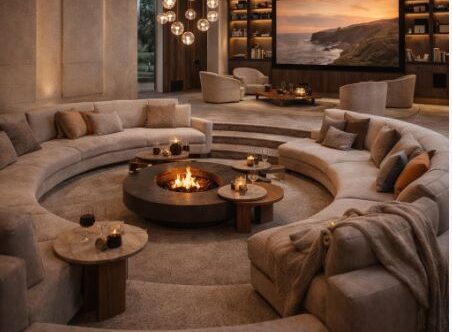
The Architecture of Connection
The living room has always been the social heart of the home, but its role has never been more intentional than it is today. As our lives grow more digital and our homes more multifunctional, the way we design living rooms directly shapes how we connect with others. Every decision—from the curve of a sofa to the angle of a swivel chair—becomes an architectural tool for human interaction.
Entertaining‑first living room layouts are not about filling space with furniture. They are about choreography. They guide movement, invite conversation, and create moments of togetherness. In this sense, design becomes social infrastructure, quietly influencing how often we gather, how long we linger, and how comfortable we feel once we do.
The Return of the Conversation Pit
Few design elements signal this shift more clearly than the return of the conversation pit. Once a hallmark of mid‑century modern homes, conversation pits are reemerging as a response to years of oversized, open‑plan layouts that often feel visually impressive but emotionally distant.
A conversation pit lowers the seating plane, subtly enclosing occupants without walls. This change in elevation creates intimacy. People face one another naturally, eye lines align, and the space encourages dialogue rather than passive lounging. It’s not nostalgia driving this comeback—it’s psychology.
In open spaces where kitchens, dining areas, and living rooms blur together, conversation pits reintroduce a sense of place. They carve out a social zone that feels protected, warm, and intentional. Whether sunken or implied through sectional geometry and rugs, the principle is the same: bring people closer, both physically and emotionally.
Curved Sofas and Swivel Chairs: Furniture With Purpose
Entertaining‑first layouts rely heavily on furniture that promotes flexibility and engagement. Curved sofas soften the room and naturally orient people toward one another, eliminating the rigid, face‑forward posture common in traditional layouts.
Swivel chairs are another unsung hero. Their ability to rotate allows guests to shift between conversation and view—turning toward a group discussion, then pivoting toward a window, fireplace, or media wall. This subtle adaptability makes guests feel at ease, never locked into a single position.
Furniture in these spaces is no longer chosen solely for aesthetics. Each piece answers a question: Does this help people connect? Does it support multiple ways of using the room? If the answer is no, it doesn’t belong.
Fixed Layouts vs. Flexible Living
One of the most important decisions in entertaining‑focused design is whether the room should feel set or adaptable. Fixed layouts—anchored by large sectionals or built‑in seating—create clarity and confidence. Guests instantly understand where to sit and how the room works.
Flexible layouts, on the other hand, use lighter pieces that can shift as needed. Modular sofas, nesting tables, and movable ottomans allow the room to transform from cocktail hour to movie night without effort.
Often, the most successful rooms blend both approaches. A strong central seating arrangement establishes the room’s identity, while secondary pieces offer freedom. The key is balance: too rigid feels formal; too flexible feels unresolved.
The Quiet Power of Tables and Acoustics
Cocktail tables and side tables play a surprisingly important role in entertaining. They anchor seating arrangements and give people a reason to stay put. A well‑placed table reduces the subconscious urge to wander, helping conversations deepen rather than fragment.
Acoustic comfort is equally essential. Large, open rooms with hard surfaces can quickly become noisy, making conversation difficult. Thoughtfully integrated acoustic panels, upholstered furniture, drapery, and rugs absorb sound and soften echoes.
When people don’t have to raise their voices, they relax. When they relax, they stay longer. Good acoustics are not noticed when done well—but their absence is felt immediately.
Dual Vignettes: Designing for Choice
One of the most effective entertaining‑first strategies is the creation of dual vignettes within a single living room. Instead of forcing all activity into one zone, the room offers multiple experiences.
A primary seating area might be designed for group conversation, while a secondary vignette—perhaps near a window or bookshelf—offers a quieter place for one‑on‑one dialogue or reflection. These zones are visually connected but functionally distinct.
This approach mirrors how people naturally gather. Not everyone wants to be part of the main conversation all the time. Providing choice makes guests feel comfortable and respected, encouraging longer, more meaningful visits.
Media Lounges That Feel Intentional
Entertainment technology doesn’t have to dominate the room. In entertaining‑first layouts, media is integrated with intention rather than default placement.
A media lounge might be subtly separated from the main conversation area, allowing movie nights without sacrificing social flow. Projector lifts are particularly effective here, transforming the room only when needed. When the screen disappears, the space returns to its primary role as a place for connection.
Thoughtful furniture placement ensures that screens never overpower seating arrangements. The goal is coexistence: a room that supports both shared viewing and shared conversation without forcing one to dominate.
Designing for the Senses
This design shift is ultimately about how spaces make us feel. Research consistently shows that sensory comfort—sound, light, texture, and spatial proportion—has a direct impact on well‑being.
Soft lighting encourages relaxation. Varied textures invite touch. Balanced proportions make spaces feel calm rather than overwhelming. When these elements align, people feel grounded—and grounded people connect more easily.
Entertaining‑first living rooms recognize that connection doesn’t happen by accident. It is designed, layer by layer, through choices that prioritize human experience over visual spectacle.
Connection as the True Measure of Success
We are no longer just choosing furniture. We are designing patterns of interaction. The best living room layouts aren’t judged by square footage or trend alignment, but by how effortlessly they bring people together.
A successful room invites guests to sit closer, stay longer, and talk more freely. It supports laughter, quiet moments, and shared experiences without forcing them.
In the end, good design isn’t about filling space—it’s about creating connection. And in entertaining‑first living rooms, architecture becomes the silent host, guiding every gathering toward warmth, ease, and human connection.