Welcome to the world of light, where seeing is just the start. Most luxury homes only have two lighting settings: on or off. It’s like serving caviar on a paper plate.
Imagine lighting design layers as a beautiful piece of music. Ambient lighting is like the base rhythm, lighting up the whole space. Task lighting is the melody, shining where you need it most.
Accent lighting adds harmony, making your favorite art or architecture stand out. And decorative lighting? That’s the solo that steals the show, like a stunning chandelier.
Forget the simple on-off switch. True elegance comes from blending these four elements together. Ready to create your own masterpiece? Let’s explore how to perfect your home’s ambiance and function.
Circadian strategy: tunable white and schedules
Our bodies have been tricked by lightbulbs ever sense Edison’s invention. Circadian lighting is real science, not just wellness talk.
Tunable white tech is more than just dimming lights. It tricks your space into feeling like it’s day or night. Morning gets cool, energizing whites, while evening gets warm, cozy tones.
I’ve set up systems that wake people up with a sunrise feel. No harsh alarm clocks needed. It’s a smooth transition from dark to light, like waking up in a nature show.
Smart homes get a lot smarter with scheduling. It’s not just about setting timers. It’s about complex algorithms that adjust for:
- Seasonal daylight changes
- Local weather conditions
- Personal sleep patterns
- Even your Netflix binge habits
It’s like having a personal circadian butler. It knows you need bright light in the morning and soft light at night. It even judges your choices sometimes.
The benefits are clear. You sleep better, feel happier, and outsmart evolution. Your ancestors hunted by sunlight, but you optimize your Zoom calls with it.
This isn’t just about lighting. It’s a fight against artificial living. And for once, we’re winning.
Color rendering, Kelvin ranges, and dimming curves
Let’s explore the three key areas that make lighting professional. Think of them as the core of good lighting – get them wrong, and your space looks amateurish.
First, we have the Color Rendering Index (CRI). It’s not just a technical detail. CRI affects how colors look in your space. High CRI (90+) makes colors look real. Low CRI makes them look dull, like artwork in bad light.
Next, we look at light’s emotional side. Kelvin tuning changes the mood from cozy to sharp. It’s not just about warmth or coolness. It’s about how it makes you feel.
Dimming curves are also critical. Linear dimming is like playing piano with oven mitts. It’s not smooth. Our eyes see light in a special way, not linearly. So, dimming should mimic natural light.
Many expensive lighting systems fail because of bad dimming. The lights don’t fade smoothly. It’s like a teenager playing whack-a-mole with the lights.
| Kelvin Range | Emotional Effect | Ideal Application |
|---|---|---|
| 1800-2700K | Intimate, cozy, relaxing | Bedrooms, dining rooms, luxury hotels |
| 3000-3500K | Warm, welcoming, comfortable | Living spaces, restaurants, retail |
| 4000-5000K | Energetic, focused, productive | Offices, kitchens, workspaces |
| 5000K+ | Clinical, alert, intense focus | Art studios, laboratories, medical facilities |
Great lighting combines good CRI, smart Kelvin tuning, and smooth dimming. It’s the difference between just lighting up a space and making it special. For more on commercial lighting, check out our commercial lighting guide.
Remember, the best lighting is felt, not seen. When these elements work together, your space feels right, not just looks good. That’s something no spec sheet can explain.
Fixtures: downlights, linear, cove, and decorative integration
Think of lighting fixtures as your design orchestra. Each part must work together without overpowering others. Downlights are like the percussion section – steady and essential.
Linear fixtures add architectural beauty, making spaces feel both big and cozy. They’re like the strings in your lighting design, smooth and emotional.

Cove lighting makes ceilings seem to float. It’s like the woodwinds – soft and magical, creating a dreamy atmosphere.
Decorative integration is what makes a space truly luxurious. I once designed a system with a Baccarat chandelier and hidden LED strips. The trick was making all parts look like they belong together.
Here’s a look at how different fixtures work together in lighting design:
| Fixture Type | Primary Function | Visual Impact | Integration Complexity |
|---|---|---|---|
| Downlights | General illumination | Subtle background | Low |
| Linear Fixtures | Architectural emphasis | Strong directional | Medium |
| Cove Lighting | Ambient enhancement | Soft indirect | High |
| Decorative Pieces | Focal points | Dramatic centerpiece | Custom |
The real skill is in balancing these elements. No clashing colors or brightness. It’s all about harmony – where science meets art.
Good lighting design layers have each fixture working together. Downlights set the base. Linear elements add flow. Cove lighting brings mystery. Decorative pieces create the wow factor.
Getting this balance right turns spaces into true works of art. It’s the difference between just having lights and having a real atmosphere.
Control protocols (DALI/DMX/0‑10V) and gateways
Welcome to lighting’s backstage pass – where protocols whisper secrets and gateways translate poetry. Think of this as the United Nations security council meeting for your luminaires.
DALI operates like a sophisticated European diplomat. Each fixture gets its own digital address and personality profile. I’ve watched DALI systems remember individual dimming preferences like a concierge recalling your favorite cocktail.
DMX brings Broadway to your breakfast nook. Originally designed for rock concerts and theater stages, it now delivers precision lighting choreography to residential spaces. The protocol doesn’t just dim lights – it conducts them.
Then there’s reliable 0-10V, the analog workhorse that powers countless installations. It’s the trusty steed in a world of sports cars – not fancy, but always gets you home.
The real magic happens at the gateway level. These intelligent interpreters smooth technical handshakes between protocols. I’ve configured systems where DALI fixtures flirt with DMX controllers through these digital matchmakers.
Consider these protocol personalities:
- DALI: Digital, addressable, two-way communication
- DMX: Precision control, perfect for dynamic scenes
- 0-10V: Simple, reliable, widely compatible
Gateways serve as the Rosetta Stone of lighting control. They translate between languages, ensuring your theatrical DMX effects can coexist with sophisticated DALI configurations. It’s the technological diplomacy that makes beautiful lighting possible without the technical headaches.
The best systems often blend protocols strategically. Use DALI for ambient layers, DMX for accent lighting, and 0-10V for simple task zones. The gateways ensure they all play nicely together.
This isn’t just technical specification – it’s the architectural framework for lighting intelligence. Choose your protocols like casting a play: each character has its role, and the director (gateway) ensures they perform in harmony.
Daylight sensors and shade coordination
Ever watched a Hollywood cinematographer at work? That’s what modern daylight sensors do for your home. They’re not like old photocells that just turn lights on at dusk. Today’s sensors measure light intensity, color, and direction with amazing accuracy.
I set these sensors to work with motorized shades in a beautiful dance. On a sunny afternoon, they adjust shades to avoid glare while keeping your view. They also change the inside lights to match the outside light.
These systems really shine when they support your circadian lighting rhythm. They adjust light as the day changes, keeping your space perfectly lit. It’s not just about turning lights on and off. It’s about making your home feel just right, no matter the weather or time.
| Sensor Type | Primary Function | Integration Level | Circadian Benefits |
|---|---|---|---|
| Basic Photocell | Simple on/off based on light levels | Low – standalone operation | Minimal – basic light/dark detection |
| Color-Tuning Sensor | Measures color temperature and intensity | Medium – shade coordination | Moderate – maintains color consistency |
| Advanced Multi-Sensor | Tracks intensity, color, direction, time | High – full system integration | Optimal – perfect circadian rhythm support |
| AI-Predictive Sensor | Learns patterns, predicts lighting needs | Maximum – weather integration | Premium – anticipatory circadian adjustment |
Sensors and motorized shades work together to make your home aware of its surroundings. Imagine your shades adjusting as the sun moves, while your lights adjust to keep everything perfect. And when clouds come, the system changes again smoothly.
This isn’t just smart home tech. It’s almost alive. It learns your habits, adapts to seasons, and even adjusts for daylight saving time. You get spaces that feel naturally perfect, without ever touching a switch.
The outcome? A home that supports healthy circadian lighting patterns, avoids glare, and keeps you comfortable. It’s not just a place to live. It’s a space that actively improves your life. Your lighting system becomes a true partner in your environment.
Scene library for lifestyle moments
Think of your lighting system as a Broadway director. They have perfect timing for every part of your day. We’re not just flipping switches. We’re choreographing light like Bob Fosse choreographed dance, with every fade and emphasis.
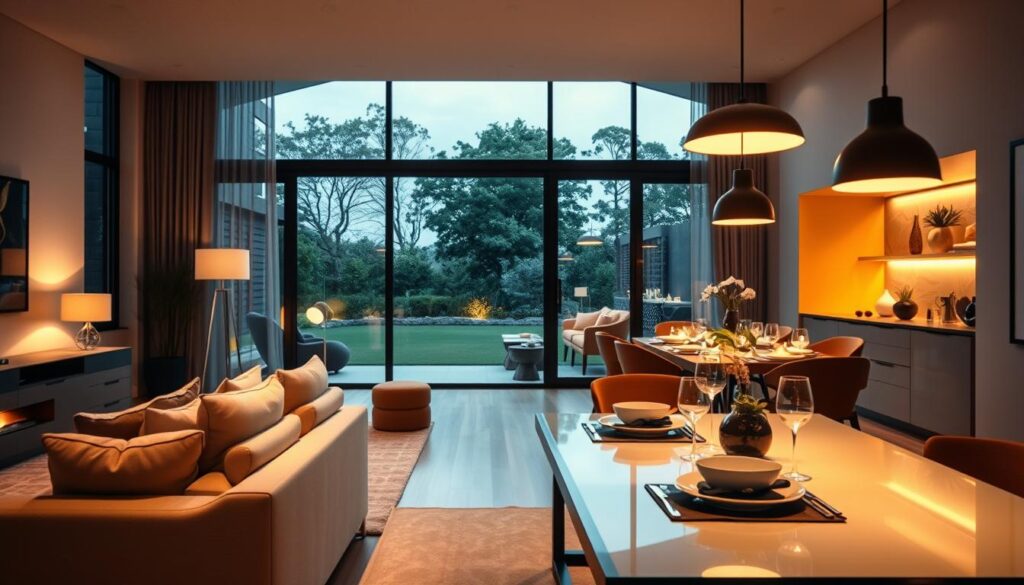
Your scene library becomes the ultimate human centric lighting guide for daily living. I once programmed a “Midnight Snack” scene. It uses pathway lighting at 1% intensity – enough to get to the fridge without fully waking you. It’s the difference between stumbling in darkness and having a considerate light butler.
Consider these curated moments: “Morning Energize” delivers cool, bright light exactly where you need it – coffee station, bathroom mirror, reading nook. “Evening Unwind” gradually transitions to warm, dimmed ambient light. It tells your circadian rhythm it’s time to relax. “Dinner Party” becomes subtle theater – perfect accent lighting on artwork while maintaining intimate background illumination.
These scenes aren’t static presets. They’re carefully timed sequences that transition smoothly between states. The “Coming Home” scene might first illuminate the entryway, then gradually bring up kitchen lights, and then activate living room ambient lighting – all within 30 seconds.
The real magic happens when your lighting anticipates needs you didn’t even articulate. That’s what separates basic automation from true human centric design. It’s lighting that doesn’t just respond to commands – it understands context.
Commissioning: dimming, fade times, crossfades
Lighting systems come to life during commissioning. It’s when code turns into feelings. Forget the specs; it’s about how light makes you feel in real spaces.
Dimming isn’t just about numbers. It’s about the feel of light changing. Different materials like mahogany and marble change how light interacts. The system must understand these differences.
Fade times need to feel just right. Too quick, it’s jarring. Too slow, it’s slow. The perfect time is between heartbeats and breaths.
Crossfades need to be smooth, like film editing. The tunable white system must blend scenes smoothly. It’s like a conductor leading an orchestra.
I spend days tweaking these settings. I watch how light interacts with materials in each space. It’s a mix of science and psychology, and it’s all-consuming. The goal is to make it feel effortless, which takes a lot of effort.
Good commissioning makes tech invisible. What’s left is pure experience. Light that feels right, moves right, and lives in your space. That’s the difference between just lighting and creating atmosphere.
Art lighting and glare management
Lighting artwork is like giving it a solo performance. It needs a spotlight, not harsh light. The right lighting makes art stand out, unlike a garage sale.
Specialized fixtures are key. They have tight beam angles and filters that make art glow. This prevents harsh light that’s like shouting in a library.
Glare management is the magic part. It’s about making light behave well. I use museum lighting techniques to make art pop:
- Grazing light that skims surfaces to reveal texture without overwhelming
- Framing projectors that isolate pieces like VIP sections at a concert
- Sophisticated baffles that prevent light spill better than a bartender prevents spills
This makes viewing art a better experience. You’ll connect with the artwork more. Your Picasso won’t look like it’s having a seizure.
The right human centric lighting guide makes art part of your life. It creates moments where only the art is visible. Your eyes will thank you, and your artwork might give you a silent standing ovation.
Good art lighting should feel natural, not theatrical. If guests need sunglasses, you’ve missed the mark. This is where human centric lighting guide shines. It creates harmony between people and art.
Maintenance, lamp life, and upgrade paths
Even the best lighting needs some care. LED tech has improved, but heat is a big problem. I make systems easy to reach for repairs, avoiding major damage.
Upgrade paths are important too. Today’s tech can become outdated fast. I design systems that can grow with new tech, saving you from big changes.
Kelvin tuning is key for future-proofing. It lets your lighting change with your tastes or new tech. True luxury is about lasting beauty, not just today’s trends.