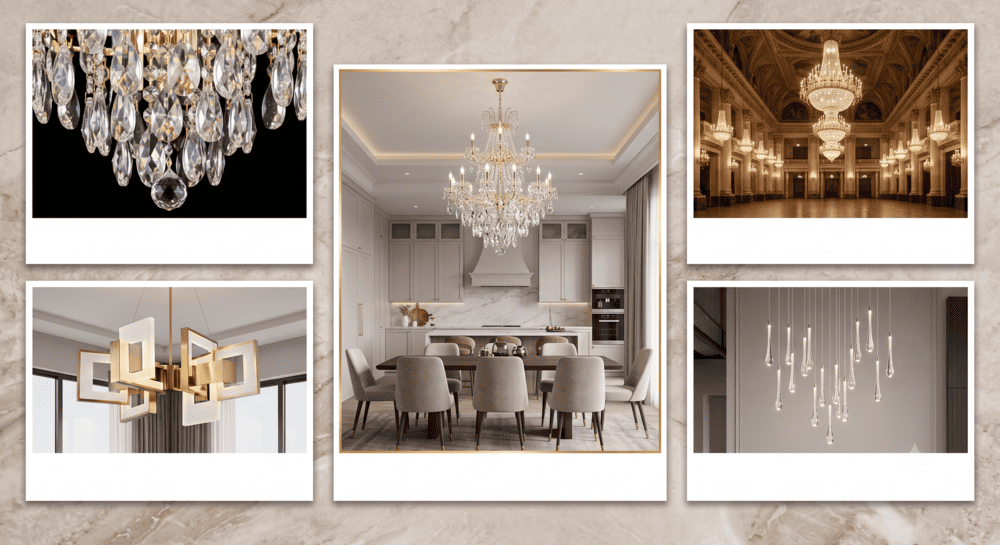
Selecting a lighting centerpiece requires precise spatial analysis. A luxury home demands fixtures that anchor the architectural volume. Chandeliers dictate the visual weight of a space, commanding attention the moment a person enters the room. We will examine the mechanics of chandelier design, focusing on scale, material refraction, technical illumination, and structural installation.In high-end residential design, a chandelier functions as more than a source of light. It acts as a spatial focal point, establishing hierarchy within the room and reinforcing the architectural intent of the property. Whether suspended above a grand staircase, a double-height living room, or a formal dining area, the fixture becomes a visual anchor that defines the atmosphere of the entire space.
Luxury chandeliers also contribute to perceived property value. Premium materials, custom fabrication, and integrated lighting technology signal craftsmanship and exclusivity, characteristics that are consistently associated with high-end real estate.
Analyzing Spatial Requirements and Proportions
Proper scaling dictates the success of a lighting installation. An undersized fixture looks insignificant in a grand space. An oversized piece overwhelms the architecture and creates an oppressive atmosphere. The standard industry calculation adds the room’s length and width in feet to determine the fixture’s minimum diameter in inches. A formal dining room measuring twenty by thirty feet requires a fifty-inch chandelier to maintain visual balance.
Vertical proportions follow a strict mathematical ratio. Designers calculate two and a half to three inches of fixture height for every foot of ceiling height. A ten-foot ceiling accommodates a twenty-five-inch to thirty-inch tall fixture safely. Grand foyers with double-height ceilings dictate much larger structural footprints. In two-story entryways, the bottom of the fixture must hang at least eight feet above the floor to provide adequate clearance for guests. Placement relative to windows matters heavily. The chandelier should center perfectly within second-story transom windows to create maximum curb appeal from the exterior at night.
The Influence of Material Selection on Light Quality
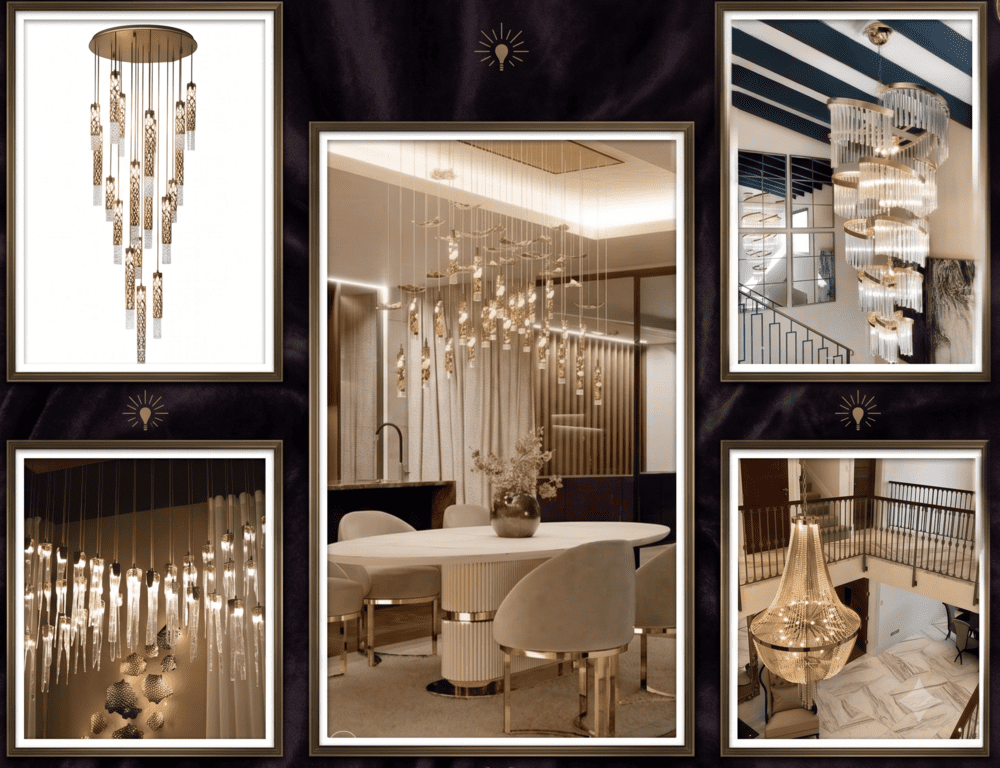
Light refraction depends entirely on material purity and geometric cutting. Traditional crystal relies on chemical additives. Strontium and lead oxides added to glass during the melting process change the refractive index. Light bends sharply upon entering the facets, creating a prismatic dispersion of rainbow colors across the room’s surfaces.
Venetian glass offers a distinct aesthetic departure from faceted crystal. Artisans formulate silica with specific mineral ashes to create opaque, vibrant colors. These hand-blown pieces offer soft diffusion rather than sharp prismatic reflections. Modern luxury design frequently utilizes brushed brass, blackened steel, and spun aluminum. The metallic choice dictates the room’s ambient warmth. Polished metals create sharp, mirror-like reflections that bounce light aggressively. Matte metallic finishes absorb glare and diffuse a soft ambient glow. We see this principle frequently applied in high-end luxury room styling where texture dictates the mood of the space.
| Material Classification | Refractive Quality | Structural Weight | Primary Application |
| Leaded Crystal | Exceptional prismatic dispersion | Very Heavy | Traditional Grand Foyers |
| Venetian Glass | Soft diffusion, high color saturation | Moderate | Dining Rooms, Salons |
| Spun Aluminum | Directional, non-refractive | Light | Contemporary Living Spaces |
| Forged Bronze | Absorbs ambient light | Heavy | Rustic Luxury, Libraries |
Technical Lighting Specifications for Grand Spaces
High-end lighting relies on accurate color rendering and precise temperature control. The Color Rendering Index (CRI) measures how accurately a light source reveals true colors compared to natural sunlight. Luxury spaces require a rating above 90 CRI. Skin tones look natural under high-CRI lighting. Fabric textures read accurately. Art collections display their intended pigments without distortion.
Color temperature, measured in Kelvin, establishes the atmosphere. Formal dining rooms and bedrooms benefit from warm light ranging from 2400K to 2700K. This mimics the flattering glow of candlelight. Kitchens and task-oriented spaces demand cooler temperatures around 3000K to 3500K for visual clarity. High-end LED chandeliers frequently feature tunable white technology. The fixture shifts temperature automatically throughout the day to match natural circadian rhythms.
Lumens measure the total light output of the fixture. A massive dining room requires focused task lighting layered with ambient glow. Dimming systems manage these lighting layers with exact precision, allowing the homeowner to shift the room from bright functionality to dramatic evening entertaining with a single touch.
Historical Aesthetics Versus Contemporary Structural Design
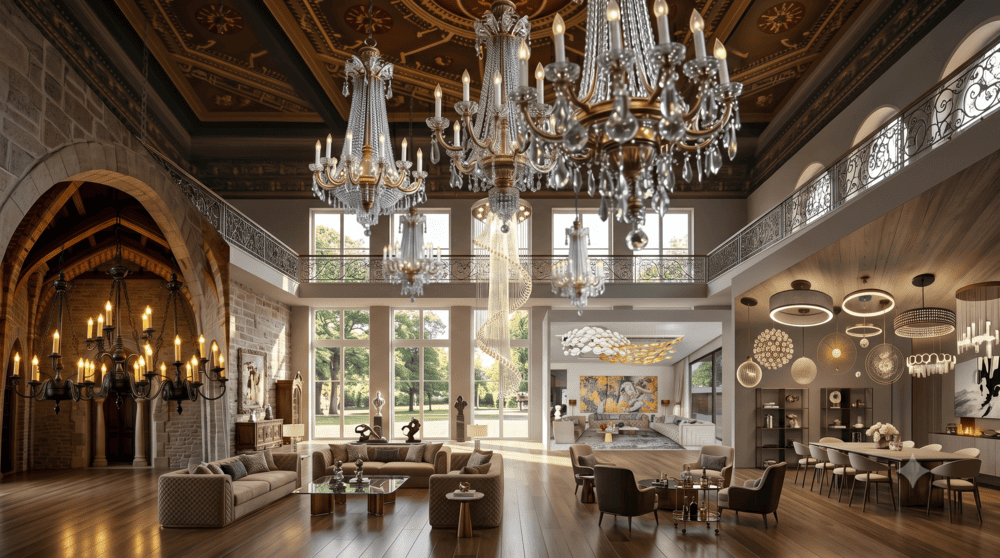
Traditional silhouettes trace their lineage back to European palaces of the eighteenth century. The Empire style features a classic hot-air balloon shape draped with cascading crystal beads. Neoclassical designs rely on symmetrical bronze arms holding candle-like bulbs. These forms carry immense historical weight. They communicate established wealth and permanence. Placing these classical forms in a minimalist modern context creates deliberate, striking architectural friction.
Contemporary luxury lighting rejects ornate detailing in favor of clean geometry. Interlocking LED rings suspended by nearly invisible aircraft cable create an illusion of floating light. Linear suspension chandeliers stretch across massive ten-seat dining tables without obstructing sightlines across the room. The engineering focuses on hiding all fasteners, screws, and wiring. The fixture becomes a pure sculpture of light and metal. High-net-worth individuals frequently commission custom pieces from industrial designers to match the exact dimensions of their dining spaces.
Integration With High-End Home Automation
Modern estates utilize centralized lighting control. Systems dictate complex dimming curves that standard wall switches cannot manage. LED fixtures require specific electronic drivers to prevent flickering at low intensities. Phase-forward and phase-reverse dimming modules must match the chandelier’s internal electronics perfectly.
Seamless integration allows the fixture to respond to astronomical time clocks. The chandeliers turn on automatically ten minutes before sunset, shifting color temperatures as daylight fades completely. Motorized shades lower simultaneously to complete the evening transition. This level of automated coordination aligns perfectly with modern interior lighting standards recognized by top architectural firms and luxury builders.
Sourcing and Verifiable Provenance
True luxury involves verifiable provenance and expert craftsmanship. Mass-produced fixtures lack the structural integrity required for high-end homes. Artisanal workshops forge individual components by hand in dedicated foundries. Buyers receive certificates of authenticity detailing the origin of the glass and metalwork.
Glassblowers utilize techniques passed down through generations to create flawless lead-free crystal that meets strict modern environmental standards. Custom commissions take months to fabricate. The client participates directly in reviewing shop drawings, metal finish samples, and glass prototypes. This intense level of client involvement guarantees the final product scales perfectly to the intended room and matches all surrounding architectural finishes.
Layered Illumination Strategies
A chandelier rarely operates in isolation within a well-designed room. Lighting designers employ layered illumination. The central fixture provides the primary visual anchor and ambient glow. Recessed directional lights highlight art collections on the surrounding walls. Concealed LED strips within ceiling coves push light upward to create an illusion of infinite ceiling height.
The chandelier acts as the visual centerpiece of the room. The hidden architectural lighting does the actual work of illuminating the room’s dark perimeters. This strategy prevents the harsh, uncomfortable glare associated with over-illuminating a single central light source. It distributes the lumens evenly across the entire square footage of the space.
Acoustics and Spatial Dynamics
Large fixtures influence room acoustics significantly. Massive glass and metal structures reflect sound waves in complex patterns. Grand foyers with marble floors often suffer from severe, unpleasant echoes. A multi-tiered crystal chandelier breaks up these sound waves. The hundreds of faceted surfaces scatter the acoustic energy, dampening the reverberation in the room.
Fabric-shaded chandeliers in dining rooms absorb high-frequency sounds. The clinking of silverware and overlapping dinner conversations soften noticeably. The physical mass of a large lighting fixture changes how sound travels through the open space, contributing to a quieter, more refined acoustic environment.
Electrical Engineering and Load Management
Massive light installations draw significant electrical current and require specialized infrastructure. Older luxury homes require total wiring upgrades to support modern, oversized fixtures safely. Dedicated electrical circuits prevent system overloads. Master electricians calculate the total wattage before running new copper lines directly from the main breaker panel to the ceiling junction.
The transition to LED technology drastically reduced total energy consumption in luxury lighting. A traditional halogen fixture drawing two thousand watts now requires less than three hundred watts using modern diodes. This technological shift reduces heat output dramatically. Surrounding paint, ceiling plaster, and delicate trim work suffer less thermal degradation over time. Advanced thermal management systems built into high-end fixtures dissipate the minimal heat generated by the LED drivers, ensuring the electronics survive for decades without failure.
Installation Protocols for Large Scale Fixtures
Weight remains the primary engineering hurdle in luxury chandelier installation. Massive crystal structures easily exceed several hundred pounds. Standard ceiling junction boxes fail immediately under such strain. Contractors must install reinforced steel bracing between the ceiling joists above the drywall.
Multi-story foyers present significant maintenance challenges for homeowners. Motorized winch systems built directly into the attic space offer the only practical solution. These motorized lifts allow the chandelier to lower straight down to floor level on steel cables. This grants the staff easy access for meticulous cleaning and bulb replacement. Structural engineers evaluate the roof trusses before installation to accommodate the combined dynamic weight of the heavy fixture and the motorized lift machinery. Safety cables provide a secondary fail-safe, ensuring the massive structure remains secure above the main living areas at all times.