
We don’t just want a hole in the wall. We want a portal. A perfectly framed slice of the world that turns a morning coffee into a private screening of the sunrise.
But here’s the architectural catch-22. That beautiful, transparent plane—our personal IMAX screen to the backyard or skyline—is also a terrible gossip. It lets in every car horn, leaf blower, and deeply personal neighborly debate.
This is where the real design work begins. It’s not about specification; it’s about choreography. The dance between solid wall and glass creates the rhythm of a room. Sill height decides if you’re in the front row or the nosebleed seats.
Get this visual syntax wrong, and your grand vista feels like a badly cropped Instagram photo. Get it right, and you’ve written the first line of a quieter, brighter story. The living room, that central stage of domestic life, demands this balance most of all.
So how do we marry the epic view with sacred silence? The answer often lies not in a single component, but in a complete system. This is the realm of intelligent glazing packages—where the science of sound meets the art of light.
Material choices aluminum steel wood clad thermal breaks and looks
Forget the glass for a moment; the real character of your window is defined by its frame. This isn’t just a structural member. It’s the chassis, the exoskeleton, the personality that whispers to the street. Your choice here is less about engineering and more about casting.
Are you building a tech startup loft or a craftsman bungalow? The frame material is your first, most telling clue.
Let’s meet the candidates. First, aluminum—the sleek, minimalist tech-bro of the group. It offers incredible strength without visual bulk, allowing for those dramatic, floor-to-ceiling glass spans. Modern alloys, like Hindalco’s Duranium, are the superhero versions. They’re about 40% stronger, resisting warping and corrosion with a silent, low-maintenance grace. If your aesthetic is “less frame, more view,” aluminum is your go-to.
Then there’s steel, the stoic philosopher. It’s phenomenally strong, allowing for the slimmest possible sightlines in historic restoration or industrial-chic designs. But steel has a classic flaw: it’s prone to existential rust. It requires a consistent, high-quality coat of paint—its rhetorical armor—to survive the elements. It’s for the purist who values timeless form over easy upkeep.
Wood is the cozy novelist. It brings warmth, texture, and a traditional soul that synthetic materials can’t replicate. It’s the classic professor’s study, full of character. But wood is a diva. It swells with humidity, shrinks in the dry heat, and demands regular maintenance—staining or painting—to avoid a melodramatic decay arc. It’s beautiful, but it asks for your attention.
Enter the savvy diplomat: the clad window. This is the mullet of fenestration: business in the front, party in the back. Typically, it’s wood on the interior for that warm, traditional feel, sheathed in a jacket of aluminum or vinyl on the exterior. The clad armor defends against weather, while the interior wood satisfies your tactile nostalgia. It’s a pragmatic compromise for many American homes.
Cutting through all this material poetry is the unsung hero: the thermal break. This is a non-conductive barrier—often a polyamide strip—inserted inside an aluminum or steel frame. Why does it matter? Metal is a fantastic conductor of temperature (and sound). A thermal break literally breaks that path, creating a barrier that drastically improves energy efficiency and reduces condensation. It’s the difference between a frame that’s a silent partner and one that’s a creaky, drafty diva.
| Material | Persona | Key Advantage | Primary Consideration |
|---|---|---|---|
| Aluminum | Sleek Modernist | High strength-to-weight, slim profiles, low maintenance | Requires thermal break for efficiency in extreme climates |
| Steel | Industrial Purist | Ultimate strength, thinnest sightlines | Must be meticulously painted to prevent corrosion |
| Wood | Traditionalist | Warm aesthetic, excellent natural insulation | High maintenance; susceptible to moisture and insects |
| Clad (Wood/Aluminum) | Pragmatic Diplomat | Low-maintenance exterior, warm interior | Higher initial cost; joint integrity is critical |
So, how do you choose? It’s a strategic trifecta. You’re balancing durability against the elements, thermal performance against your energy bill, and aesthetic against your home’s story. That slim aluminum frame might sing in a Miami high-rise but shiver in a Minnesota winter without its thermal break. The noble wood might perfect a New England cottage but warp in Arizona’s dry heat.
The frame is the handshake between your interior vision and the outside world. Choose the material whose personality—and maintenance manual—you can live with for decades.
Performance numbers U factor SHGC STC DP and why they matter
Think of performance ratings as the nutritional label for your windows—they tell you what’s inside beyond the glossy packaging. Sales brochures talk about “premium feel” and “elegant lines.” But these numbers? They’re the unvarnished truth. Ignoring them is like buying a sports car because you like the stitching on the seats.
Let’s decode the alphabet soup. Each acronym is a specific, measurable superpower—or weakness—in your window’s DNA.
U-Factor: The Insulation GPA. This number rates how well your window stops heat from escaping. Think of it as a grade for thermal laziness. A lower U-factor means a better insulator. In a chilly climate, a high U-factor window is basically a polite hole in your wall, waving your expensive heated air goodbye.
SHGC: The Solar Sunscreen. The Solar Heat Gain Coefficient measures how much of the sun’s furnace-like energy passes through the glass. A lower SHGC means better blocking. If your west-facing wall gets baked each afternoon, a low SHGC is your best defense against turning your living room into a sauna.

Now, for the urban symphony. STC (Sound Transmission Class) and its cousin OITC (Outdoor-Indoor Transmission Class) are your acoustic bodyguards. STC covers the typical range of speech and city clatter. An STC of 27? You’ll hear your neighbors’ conversations like you’re in the same room. Bump it to 45+, and that jackhammer outside becomes a distant, rhythmic tap.
OITC is the specialist for low-frequency rumble—the bass note of buses, planes, and subway trains. For true peace, you need both ratings working in concert.
DP: The Bench Press Rating. Design Pressure measures how much wind force a window or door can structurally resist. It’s the product of rigorous testing, often certified by standards like those from WiWA (the Window & Door Manufacturers Association). A high DP rating means your unit won’t flex, leak, or fail when a storm hits. It’s the difference between confidence and catastrophe.
Speaking of WiWA, their certifications for air infiltration (measured in cubic feet per minute), water resistance (in Pascals, Pa), and structural load (in kilopascals, kPa) are the gold standard. They translate marketing promises into hard, physical facts.
So, why do these performance numbers truly matter? They are your objective armor against subjective sales pitches. They answer the only question that counts: “Will this product solve my actual problem?” Choosing based on these ratings isn’t just smart; it’s the only way to ensure your investment in light, view, and comfort isn’t undone by a decimal point.
Glazing options low e coatings tints laminated and privacy glass
Forget the single-pane past. Today’s glazing package is a multi-layered defense against heat, cold, noise, and prying eyes. It’s not just glass; it’s a custom filter for your reality.
Low-emissivity (low-e) coatings are the invisible heroes. They act like a microscopic thermal mirror. In winter, they keep warmth in. In summer, they keep solar heat out. Visible light passes through without a hitch. It’s a smart way to save energy.
Laminated glass is the sound warrior. It has a clear plastic interlayer (usually PVB) between panes. Sound waves hit it and get turned into heat, not sound. This makes it great for quieting down spaces.
For better soundproofing, use panes of different thicknesses. This stops them from vibrating in sync. It’s like silencing a group of singers.
Glazing also controls light and view. Tints cut down glare and heat from the sun. Privacy glass keeps your space private, letting in light but not prying eyes.
| Glazing Component | Primary Function | Best For |
|---|---|---|
| Low-E Coating | Reflects infrared heat | Energy efficiency, reducing HVAC costs |
| Laminated Glass | Dampens sound vibrations | Urban areas, home theaters, noise reduction |
| Dual-Pane with Argon | Insulates against temperature transfer | All climates, foundational thermal comfort |
| Tinted Glass | Reduces glare & solar heat gain | Sun-drenched rooms, glare control |
| Privacy Glass | Obscures view while admitting light | Bathrooms, street-facing windows |
Your glazing package is a custom mix. You choose for light, quiet, and energy. Don’t just order the usual. Pick your layers, gases, and coatings. That’s where the magic and science of comfort come together.
Large openings sliders bifolds pivot doors thresholds and drainage
The magic of a wall of glass is not just in what you see. It’s about what you don’t see: hidden drains, precise thresholds, and silent slides. These large openings turn a solid wall into a temporary idea. They rely on a few mechanical tricks and smart waterproofing.
Sliding doors move on a track, perfect for those who love glass and views. Modern versions have anti-lift features to keep them secure in strong winds. Bifold doors fold up, making a big wall section open. And the pivot door swings on a central axis, making a bold statement.
| Door Type | Movement & Character | Best For | Key Spec Consideration |
|---|---|---|---|
| Sliding Door | Linear glide, space-saving | Seamless daily access, wide views | Track smoothness, anti-lift security, panel weight |
| Bifold Door | Folding stack, full opening | Complete indoor-outdoor merger for entertaining | Hardware load, stack space, header support |
| Pivot Door | Centered swing, grand gesture | Focal point entries, dramatic effect | Structural pivot point, floor clearance, weight distribution |
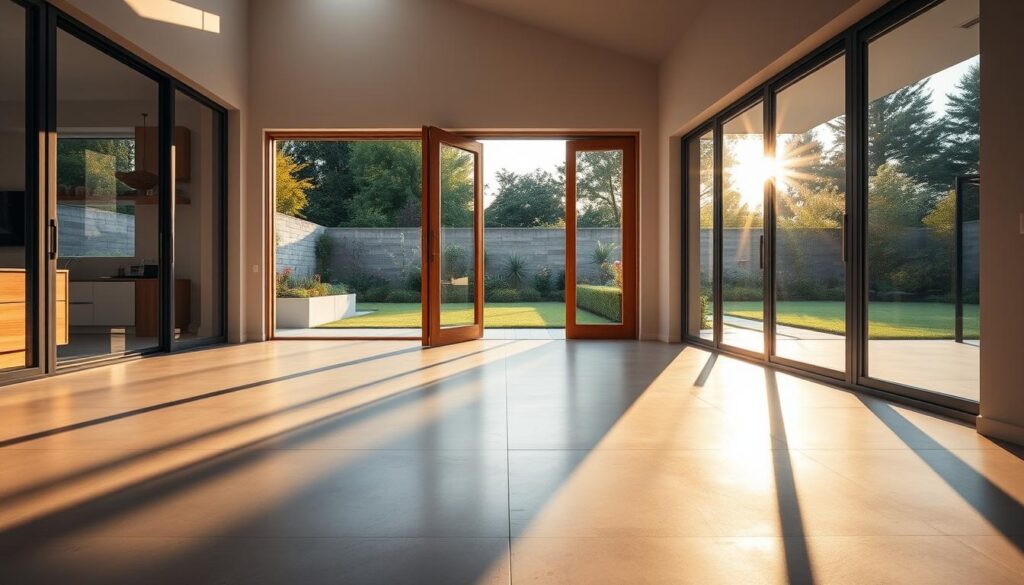
The threshold is a key part of every large opening. It’s not just a bump to stub your toe on. It’s a special area that keeps your inside dry and your outside wet.
Get the threshold wrong, and you’ll have a damp problem. A good threshold system has a subtle slope, hidden weep holes, and seals. Water hits the exterior sill, is channeled away, and exits through weep holes, keeping your space dry.
Choosing these systems is about creating a temporary wall absence. It’s about working with the building’s drainage and managing sun exposure. You want a view that’s beautiful and doesn’t let in drafts or leaks. Exterior shading solutions can help with this.
Hardware feel hinges closers multipoint and finishes
Forget about what’s written on paper. The real test of a window or door is how it feels. The hardware is like a handshake, connecting you to the building. A flimsy handle is like a broken promise. But a solid, smooth lever feels like a promise kept.
Hinges are the backbone of a door or window. They must hold the weight for years without sagging. Think of a grand piano lid. You wouldn’t use a cheap hinge on it, and your home shouldn’t either. Hinges are in aluminum, steel, or wood frames, fighting gravity’s pull.
The closer is the final touch. It’s not about slamming doors. It’s about a smooth, sure seal. A good closer is like a maître d’, guiding the door with grace. This ensures a tight seal, keeping out drafts and noise.
Multi-point locking systems are the real heroes. They’re not just for security. They enhance performance. By locking at top, middle, and bottom, they ensure a tight seal. This is key for acoustic comfort and thermal efficiency.
Finishes are the final touch. They’re not just colors. They’re statements. The right finish can make aluminum clad look industrial-chic, warm up steel, or highlight wood. It ties everything together.
So, what should you look for? Here’s a short list:
- Weight and Action: Parts should feel substantial and smooth, not gritty or light.
- Material Compatibility: Finishes and fasteners should match your frame material, like aluminum, steel, or wood, to prevent corrosion.
- Security Integration: Systems should have at least three locking points and work with smart home sensors if you want.
- Finish Durability: Look for PVD or anodized coatings that resist wear, fading, and fingerprints.
Specifying hardware is like curating an experience. You’re designing how you interact with your space every day. You wouldn’t put cheap hardware on a fine piece of furniture. So, why do it with your home? The feel is the message. Make sure it’s one you want to share every day.
Weather and security air water structural ratings and sensors
When the weather gets bad, your home’s performance ratings become key. Your windows and doors are your home’s shield. They keep you safe and cozy.
Think of your home as a shield with three layers. The air infiltration rating keeps drafts out. A small gap can let in cold air and noise.
The water penetration resistance rating is next. It keeps rain out, even in strong winds. A high rating means you can enjoy watching the weather, not worrying about it.
Structural performance is the last layer. It’s the strength of your home against wind. A high rating means your home stays strong, even in storms.
These ratings are more than numbers. They protect your home from the elements. A small gap can affect your comfort and sound quality.
Now, let’s talk about the tech side. Modern systems use sensors for better protection. Contact sensors and moisture sensors work with your security system. They alert you to any issues before they become big problems.
This tech turns your home into a smart fortress. You feel safe, and the data backs it up. You’re not just keeping the weather out; you’re watching your home’s health in real time.
| Rating Type | Test Pressure (Example) | Defends Against | Real-World Implication |
|---|---|---|---|
| Air Infiltration | 600 Pa | Drafts, noise infiltration, energy loss | A silent, draft-free interior even on a windy day. |
| Water Penetration | 750 Pa | Wind-driven rain leakage | No water stains or leaks during a heavy storm. |
| Structural Performance | 2.75 kPa | Wind load, frame deflection, glass failure | The assembly stays rigid and intact under extreme weather. |
Specifying for weather and security is a two-step process. First, you look for proven, quantified resilience. Then, you add smart monitoring. This turns your home into a safe haven, not just a place that meets code. The view is beautiful, but the real luxury is peace of mind, no matter the weather.
Installation details pan flashing integration and thermal bridges
You’ve picked the top-notch window, but poor installation ruins it. It’s like putting a Ferrari in a mud puddle. Your perfect windows can fail if installed badly.
The window unit is the star, and the rough opening is the stage. Pan flashing is the unsung hero, keeping water out of the wall. It’s like a bouncer, keeping moisture out.
Sealing is key, not just any caulk will do. You need a flexible sealant that lasts decades. It absorbs sound, not transmits it. Seal all gaps to block sound.
Integration is the next step. The window’s weather barrier must match the building’s wrap perfectly. A good installation means no air or water leaks.
Thermal bridges are silent killers. They let heat and cold pass through, bypassing insulation. This ruins your energy efficiency.
Condensation on frames is a problem in winter. Your insulation is wasted. Fixing this means using thermal breaks and careful detailing.
Proper installation makes the window part of the wall. It’s not just a plug. This stops sound and heat leaks.
| Component | Primary Function | Common Failure Point | Pro Tip |
|---|---|---|---|
| Pan Flashing | Directs incidental water out of wall assembly | Not integrated with main weather barrier, or omitted entirely | Use a flexible, self-adhering membrane that ties into the wall wrap. |
| Acoustical Sealant | Seals gaps to prevent flanking noise transmission | Using standard hard-setting caulk that cracks over time | Specify a non-hardening, gun-grade sealant for all perimeter joints. |
| Weather Barrier Integration | Creates a continuous water and air barrier | Poor coordination between window installer and siding crew | Detail the “shingle-lap” sequence in drawings: wrap over flange, then flashing tape. |
| Thermal Bridge Breaker | Isolates conductive frame from structure | Direct metal-to-metal contact between frame and rough opening | For large openings, use structural thermal spacers and insulated backer rod. |
Installation is not just the end. It’s the start. It turns parts into a working system. Get it right, and your windows will perform well. Get it wrong, and they’re expensive reminders of missed details.
Coordination with shades screens and drapery pockets
Your view is perfect, and your acoustics are great. But the sun doesn’t care about your U-factor. Even the best glazing packages have limits. They’re the start, not the end.
The final touch is in the shades, screens, and drapes you choose. Without them, your windows look cheap. It’s all about how you finish them.
So, what’s your choice? Do you like the look of between-the-glass blinds? They’re hidden and dust-free. They’re perfect for those who like a clean look.
Or maybe you prefer motorized roller shades? They’re easy to control with your phone. It’s like magic.
Textiles can also make a big difference. Floor-to-ceiling drapes add drama and texture. But you need to hide them when open.
Use a drapery pocket to hide the fabric. It keeps your lines clean. This is where design meets function.
Don’t forget about acoustic curtains. They add sound absorption. It’s like velvet for your ears.
Windows are tools for living. The glazing package handles the science. Treatments add the beauty and privacy. Specifying them together shows you care about the details.
Get it right, and your view will always be perfect.
Mockups field tests and warranty registration
Think of your specification as a movie script. The mockup is the final scene before the premiere. It’s your last chance to see your window wall under the lights. You get to operate the hardware, watch the light fall, and feel its weight. This isn’t a luxury. It’s essential.
But the studio lot isn’t the real world. You must test on location. As detailed in a guide to field mockup testing, verifying installation with on-site tests is the only way to know if your design survived construction. Did the electrician compromise a seal? A field STC or OITC acoustic test will reveal the truth. This step validates the promised performance ratings where it counts.
Your final performance ratings are only as good as the installation. A robust warranty, like Eternia’s offer of 12 years on frames and five on hardware, is a manufacturer’s bet on its own product. But it’s not automatic. You must formally register the product post-installation. This bureaucratic step is the closing credit sequence. It transforms a purchase into a long-term relationship. It’s the insurance policy that makes the performance promise stick.