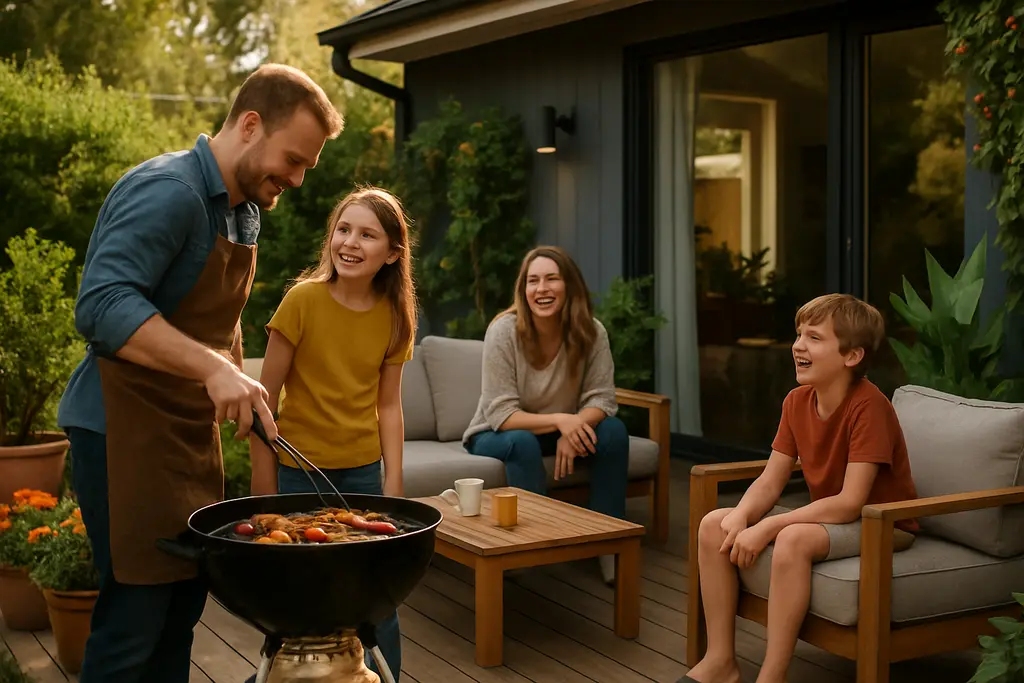
Outdoor living ROI is not only a resale calculation. For many homeowners, the more useful question is whether a project will make daily life better without pushing cost, safety, or maintenance beyond what the household can reasonably support. That is the tension behind many backyard projects in 2026: owners want patios, seating, dining areas, shade, and lighting they will use often, but they also do not want to overbuild for a feature that may return less than expected at resale.
Recent outdoor renovation research supports that shift. Houzz reported that only 15% of U.S. homeowners said improving resale value was their main reason for outdoor renovations in 2026, while 25% renovated to make outdoor spaces more accommodating for daily use. The same Houzz release reported that 83% of renovating homeowners included a lounge or seating area, and 55% added an outdoor dining area, pointing to practical comfort rather than showpiece design as a central priority Houzz outdoor renovation findings.
How Outdoor Living ROI Fits A Real Project Brief
A Case Study Lens For Outdoor Living ROI
Consider a typical homeowner brief: the yard is usable but underdeveloped, the family wants more time outside, and resale value still matters because no one can predict a future move with certainty. This is not a call to install the most expensive feature the yard can hold. It is a planning exercise that ranks daily use, cost recovery, upkeep, and safety before a contractor is asked to price a design.
In that type of project, outdoor living ROI should be discussed early, before sketches become fixed expectations. If the family eats outside twice a week during mild weather, a safer and more cost-aware plan might start with a level dining surface, shade, access to the kitchen, and lighting designed by qualified trades where wiring is involved. If the family rarely cooks outside, a full outdoor kitchen may not match the actual use pattern, even if it sounds appealing during planning.
Separating Enjoyment From Resale Pressure
A project can be worthwhile without being the highest financial return available. Seating, dining, and shade may improve daily use even if they do not all perform equally at resale. The safer planning move is to assign each element a purpose: daily comfort, easier hosting, lower maintenance, drainage correction, safer circulation, or market appeal.
This helps prevent a common mistake: treating every upgrade as if it will pay for itself. Published cost recovery estimates vary by project type, market, condition of the existing yard, and buyer expectations. A feature that brings high personal enjoyment may still have a weaker resale case than basic maintenance or modest hardscape repair.
What The Cost Recovery Data Suggests
Maintenance Often Performs Better Than Flash
The National Association of Realtors and National Association of Landscape Professionals data summarized by NALP shows wide differences in cost recovery for outdoor projects. The report lists standard lawn care at an estimated $415 cost with 217% cost recovery, maintenance of planted areas at a $4,800 cost with 104% recovery, an outdoor kitchen at a $15,000 cost with 100% recovery, and both an in-ground pool at $90,000 and a fire feature at $9,000 with 56% recovery NALP cost recovery summary.
Those figures do not mean every homeowner should avoid pools or fire features. They do suggest that enjoyment and payback should be treated as separate columns. A pool may be central to a household’s routine in a warm climate, but the same pool can add maintenance, safety responsibilities, and buyer hesitation in another setting. A fire feature may be enjoyable, yet it requires careful attention to local rules, clearances, fuel type, and professional installation when gas lines or permanent electrical work are part of the plan.
Use Data As A Filter, Not A Promise
Return estimates are best used to compare relative risk, not to promise a sale price. A lower-cost yard refresh may be easier to justify because it can improve appearance, reduce deferred maintenance, and support broad buyer appeal. A higher-cost buildout needs a stronger personal-use case because the financial recovery may be less predictable.
For homeowners who want another practical angle on daily-use planning, this related piece on outdoor renovations for personal enjoyment looks at why comfort, lighting, and low-maintenance choices often deserve more attention than resale hopes alone.
A Safer Scope For Enjoyment And Payback
Start With The Parts People Use Most
The strongest first phase is often the one that removes friction from everyday use. That may mean a stable surface for chairs, a table location that does not block circulation, shade where afternoon sun is harsh, and lighting that supports safe movement after dark. These choices are less dramatic than a full backyard rebuild, but they tend to shape whether the space is used on ordinary weekdays.
Safety should set the edges of the plan. Homeowners should avoid DIY work on gas lines, permanent electrical circuits, structural deck changes, major retaining walls, or drainage alterations that could affect the foundation or a neighboring property. Those tasks call for qualified professionals and, where required, permits and inspections through the local authority. Even seemingly simple outdoor lighting can cross into electrical work that should not be improvised.
- Daily-use features: seating, dining space, shade, and safe walking paths.
- Cost-control features: phased work, simple shapes, durable materials, and repair of existing usable areas.
- Professional-scope items: structural decks, retaining walls, gas appliances, pool systems, and permanent wiring.
- Resale-sensitive choices: neutral finishes, practical access, moderate personalization, and manageable upkeep.
Phasing Can Protect The Budget
Phasing is often a sound compromise. A homeowner might first address grading, drainage, seating, and dining, then wait before adding higher-cost features. This creates time to see how the space is actually used. It also reduces the chance of spending heavily on an outdoor kitchen, fire feature, or specialty structure that becomes an occasional novelty rather than part of weekly life.
Phasing should still be planned as one coherent project. If future lighting, a pergola, or an outdoor cooking area is possible, the homeowner and contractor should discuss placement, access, and utility needs before the first phase begins. That does not mean installing everything at once. It means avoiding preventable demolition later.
Design Choices That Keep A Project Broadly Useful

Comfort Should Not Create Excess Upkeep
Comfort features need maintenance discipline. Upholstered outdoor furniture, wood structures, stone surfaces, and planting beds all require care. A design that looks calm on installation day can become frustrating if cushions must be stored daily, leaves collect in hard-to-clean corners, or irrigation overspray stains new surfaces.
Durability should be evaluated in plain terms: who will clean it, how often, with what products, and how will it age in local weather? A homeowner planning to stay for many years may accept more upkeep for a feature the family loves. A homeowner who may sell sooner should be more cautious about highly personal choices or systems that make buyers worry about maintenance.
Broad Appeal Does Not Mean Bland
Broadly useful design can still feel personal. The key is to place personality in flexible layers: furniture, planters, cushions, and movable shade where appropriate. Fixed elements are harder to change, so they usually benefit from simple forms, safe circulation, and materials that do not depend on a narrow style trend.
For households comparing outdoor upgrades with larger property plans, a related network resource such as Jimmy Guthrie Real Estate can be a starting point for broader housing context. For the project itself, design and construction decisions should still be checked with qualified local professionals who understand site conditions, permits, drainage, and safety requirements.
Practical Outdoor Living ROI Decisions
The best outdoor living ROI decision is rarely the biggest project on the first estimate. It is the scope that solves real use problems, stays within a manageable budget, and avoids unsafe shortcuts. If resale is the main goal, the data favors care, repair, and broadly appealing improvements. If long-term enjoyment is the main goal, comfort features may deserve a larger share of the budget, but only after maintenance, safety, and professional-scope work are understood.
A balanced case study outcome would not be measured by one number. It would ask whether the family uses the space more often, whether the project avoided unnecessary high-cost features, whether hazards were handled by qualified pros, and whether the finished yard would still make sense to a future buyer. That is a more reliable way to judge outdoor living ROI than assuming every attractive backyard feature will return its full cost.